Author interview: Scott Telek on Good Knights
As The Swithen series releases its eight book, bringing us a third of the way through the 25-novel retelling of the medieval Arthurian legend, author Scott Telek discusses the novel.

Congratulations on completing the eighth book. How does it feel to be this far into the series?
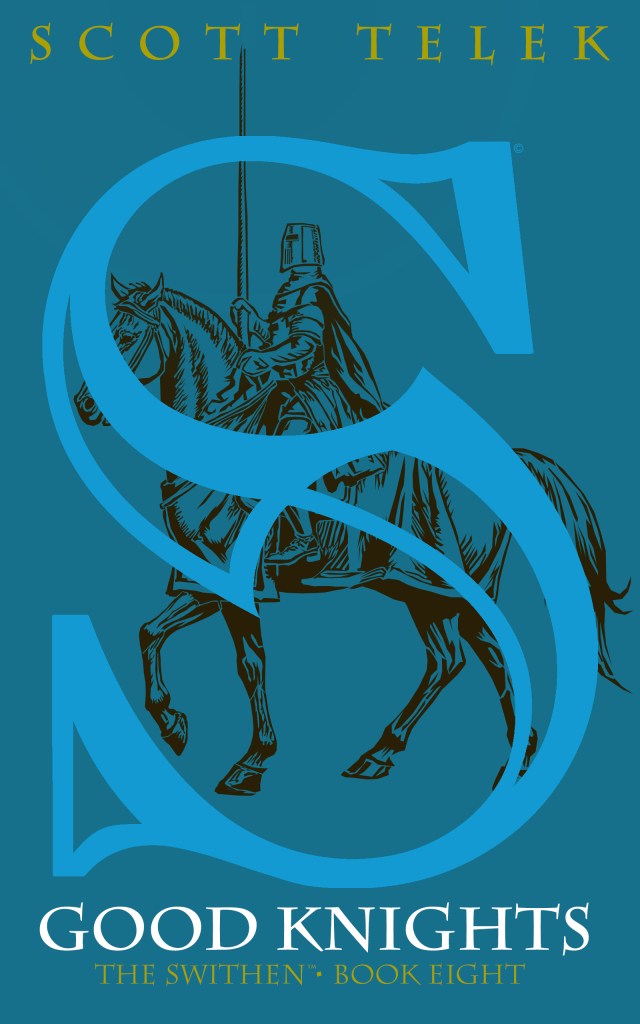
It’s great! It’s hard to say that the first six books are just the setup, but the first three bring us to the point Arthur is born, then the next three follow Arthur’s childhood and first years of rule, so really, with Book Seven is where the adventures of Arthur’s knight’s start. The series will enter a different phase after this one. In Book Eight, the major event happens that truly kicks off the adventures of Arthur and his knights that will continue until the quest for the Holy Grail, so we are heading into the meat of the series here. Also, we are now mostly with the set of characters that we will be following until the end, so it is all going to be one long interwoven saga from now on. Even the graphic on the cover moves from rough and basic toward more sophistication, and that mirrors the way the society in the story will start to evolve.
You’ve said that this story is one of your favorites in the Arthurian story. Were you nervous about doing justice to it?
Oh yes, for sure. The story originates in the Post-Vulgate, but then Malory does a really excellent job of retelling it in Le Morte d’Arthur that it is supremely spooky and macabre. So I wanted to expand it into a fleshed-out telling that people could get involved in without losing the spooky quality of it. Of course you know, sometimes expanding something or explaining it too much drains all the mystery and drama out of it, so I really worked to keep the spookiness of the story. We’ll find out how I did when I hear from readers.
Why did you decide to split the Balin story across two books?
The initial decision was made in order to preserve some of the surprises that happen. That decision was made fairly early on, when just plotting out the series, and I have to say it had a big effect on the series as a whole, because with books like this, you have to decide if each book is going to be self-contained, meaning the stories will all resolve within the book, or if it’s going to be like a serial, with storylines stretched across multiple books. I ultimately decided I was going to focus on giving the best experience to those readers who really dive in and pay attention, so I went with the serial approach, and the decision to split this into two books was a big part of coming to that approach to the series.
For these books, however, it yielded unexpected dividends, because the first part of Balin’s story is so different from the second. The first part begins to develop this question around why Balin won’t go back to King Arthur after he has done enough to win his way back into Arthur’s court, and I found that when this story then begins with Balin just on the cusp of coming back, it is unexpectedly moving, because he is vulnerable and really wants it. Then the rest of the story follows a very different thread and has a totally different tone from the first, so in retrospect I’m glad I separated it into two stories.
In this book Guenever completes her transformation to a full-on villain.
Yes. All of the stuff that happens here is implied but not shown in the source legend. Guenever has one big storyline coming in a future book, and I really enjoyed taking the time for us to see her gradual turn from sympathetic to villain… although in many ways, she is still sympathetic, once we understand what she has gone through. I’m so glad to develop a story for Guinevere, the future queen, that is completely separate from Arthur or the knights, and we will see that her former friend exerts quite an influence over the rest of the tale—including her marriage.
There’s a lot of drama with Pharian, Ban and Bors.
One thing about this telling is that a lot of the servants have storylines of their own, and it’s important to develop them so we know who they are, and they are actually woven into the story, by the time they step into the spotlight. But it can get confusing, and I have to keep my spreadsheet of plot and characters updated. In the next book, Pharian and Wyott, Ban’s new seneschal that we met in this book, will have fairly big roles, and so will Saraide, the Lady of the Lake’s assistant. Pharian continues to be a big deal in Book Ten.
In that vein, in Book 8 you introduce Galehaut and Dame Brisen.
Yes! It was a decision when to introduce Galehaut, since he won’t enter the story until several books from now, but I had a strong wish to show his mother, the wonderfully-named Fair Giantess, and give a hint at the vulnerability that comes with his character. As for Dame Brisen, she is such a wonderfully evil character, so fun, so I couldn’t resist filling in a bit of how she came to be in the position she eventually takes.
Can you offer any thoughts on why you think Balin is the way he is?
I think it’s a mix of character and his symbolic place in the overall narrative. I read a lot of academic papers that interpret the story just in order to reassure myself that I am not wildly off in the way I see it, and there was one that really made total sense. It positioned Balin as the anti-Galahad, who will come into the story more than five books from now. Balin causes the Dolorous Stroke, which creates the Waste Land, both of which necessitate the quest for the Holy Grail coming way on down the line. So Balin is both very moving as a character, in part because he seems so plaintive and desperate, and at the same time he is so bewildered by why everything is going so badly for him, and really just doesn’t seem to have a clue about it. I was really looking forward to writing this book because I wanted to delve into who Balin is, but we now turn to Gawain and soon, Lancelot, so there will be plenty of interesting characters to explore.

