The Swithen Books 1-3 Video Synopsis

What’cha doin? Not much? What if I told you that you could watch a 9-minute video that summarized the entire first trilogy of the Swithen series (the parts before the future King Arthur joins the story) and be ready to hit it when Book 4 comes out in a few months?
Would You say that 9 minutes is an eternity in a world where 10 seconds is too long for anyone to pay attention? I would sigh, then quietly reply “I know.”
Nevertheless, there it is. Since Book 4 is coming, and in Book 4 Arthur himself becomes the main character–so now our King Arthur book series actually has King Arthur in it–I have to face that a fair amount of people will begin the series here. And so, to welcome them, and ensnare anyone else who might be intrigued, or those–like you, perhaps?–who have been curious about the series but don’t have time to read the books.
Here you have a quickie summary that takes us from the birth of Merlin, through three kings and finally brings us right up through Merlin’s manipulation of Uther and Igraine to create Arthur. Find out what’s going on in all those books you’ve followed but not yet been able to read!
You can also forward it to your friends and relatives to show them what they’ve been missing.
If you’re a knowledgeable Arthurian, you’ll be able to see the ways in which I have skewed or added to the elements of the original legend in order to make them all form one complete narrative.
And if you have read the books… thanks! And I love you. I hope you liked them. You’re welcome to watch the video, too! You’ll see my cool Twin Peaks: Fire Walk With Me T shirt, which I got WAYYYY before the latest Twin Peaks revival.
I’m still at work proofreading and doing final edits on Book 4, but it’s looking definitely to be ready by the end of March (if you pre-order it for only 0.99, it says it comes out in October, but that’s only because I chose a date way out so I don’t get stressed… it’ll be April at the very latest). Also… it’s really good. I’m really happy with it. I hope everybody likes it.
Check out the Book 1-3 synopsis video and let me know what you think!

Crafting King Arthur’s childhood: Scott Telek author interview

Greetings friends, I’m getting very excited for the release of Book 4 in my Swithen series, which will tell my version of King Arthur’s childhood (and you can pre-order a Kindle edition right now!). Why am I excited? Well for one, because I think it’s a really great book. Second, because the whole series takes a big turn now, because the main character of the series is now in the story! So from now on, the next 21 books are all going to stay with Arthur (with some diversions), and be one continuous story in which we’re going to follow Arthur, Guinevere, Gawain, Merlin and Lancelot from birth, through childhood and adolescence, into adulthood and until they die.
Go right to the Book 4 Author Interview
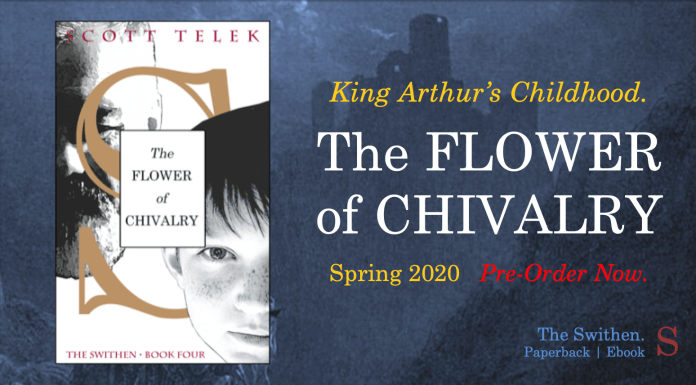
Another thing special about this book is that it is one of a very few novels that purport to tell about King Arthur’s childhood. The big other one is T.H. White’s The Sword in the Stone, part of his Once and Future King series. The other other one is John Matthews’ Sword of Ice and Fire, which I reviewed on this site a few months ago. As far as I know, those are the only others, so it’s a topic that has been touched on less than one might think.
Also, there is pretty much nothing about Arthur’s childhood in the legends, which means that this book will be unique among the series for being 98% original story, made up by me. As you know, my series is committed to remaining faithful to the pre-1485 Arthurian legend, so most of the books come with the main story points laid out. Not this one (and not the majority of the next one, either). These are going to be largely original works, so now you’ll be able to see if I can craft a story without having the outline made up for me!
That said, I love the tone of the novel. One of the things I am happy about this series is that every book in the series has a different tone–sometimes even a different genre–while they are telling one continuous story. The last one was very dark and arduous, but this one is very light, sweet, lyrical and gently humorous (until, of course, it’s not). It’s very much in the vein of an old-fashioned boy’s adventure novel, filled with a lot of gentle family comedy and drama with Arthur and his brother Kay, Mom and Pop Ector, and their friend Pedrawd and his sons Bedivere and Lucan.
Anyway, go over and read the author interview about Book 4: The Flower of Chivalryand secure your copy (it says October, but I’m actually aiming for March or April) by pre-ordering a Kindle edition. And please, please, any mention you make of my books to your friends and family, online reviews or mentions on social media are invaluable and greatly appreciated.
Thanks!
xoxox Scott
Imagining King Arthur’ childhood

Greetings folks, guess what? There’s a new review of John Matthew’s The Sword of Ice and Fire over on my website! Let no time be lost and get over there and read it!
Still here? Okay, let’s have some more background. I read this book because I am working on Book 4 of my The Swithen series, which will be my vision of King Arthur’s childhood. Matthew’s book is also an imagining of Arthur’s childhood, so I both wanted to see what he did, and also ensure that my book wasn’t too similar. I was actually more than halfway through my initial draft when I started, so you can imagine I had some worry when I finally got to it!
Luckily, the two books have almost nothing in common. Matthews’ in a young adult novel, where mine is going to be an adult novel about a kid. His takes place on the isle of Avalon, where mine is going to take place in a small medieval town. Matthew’s novel takes place mostly in a castle, whereas in mine Arthur is out in the forest exploring and discovering nature. In his novel, Arthur’s adoptive parents and foster brother are there, but not a huge focus, where my novel is going to have large elements of family comedy and drama with lots of talks around the dinner table and other elements that I hope can make it resonate with contemporary readers. Matthews book also focuses, as most Arthurian stories do, on the heroism, valiance and honor of the story, whereas I realize that a big interest of mine is including the failures of the characters, that they learn from, and also the fears and outright terror that often exist right under that outward bravery.
You might be surprised (as I was) to learn that Matthews’ book is currently one of TWO existing works that imagine a childhood for King Arthur. The other is T.H. White’s The Sword in the Stone, part of his Once and Future King. You would think there would be more, but there aren’t (when my book comes out, the total will rise to three!). The actual Arthurian legend doesn’t cover this period at all, it just goes straight from Uther’s death to Arthur’s pulling the sword, so this entire period is up for grabs for the writer. Interestingly, we also DON’T have any indication in any legend that Merlin was with Arthur in childhood, so any version that you read or see that has Merlin as a mentor to Arthur as a child is influenced by The Sword in the Stone, showing how very influential that novel was.
I’m very excited about my novel and some of the twists it has. It will be very, VERY different in tone from the rest of the books so far, being a very light, sweet “boy and his dog” style novel of childhood—at least until it goes very dark—and I hope readers really like my young Arthur, and the time we spend getting to know him in his formative years will really inform us once he grows into adulthood and settles into his role as king. One of the things I think is going to be amazing if done right—once we get to Book 7 or so, let alone 14 or 20—is the feeling that we remember this character from when he was a boy. Of course, by the time the series is over, we should have that feeling for nearly every character in the saga. It is very exciting, as I write Book 4, to create the childhood of a character we’re going to follow into adulthood and all the way to his death, and to think about what formative experiences he might have that will create the person we know later.
And if you want to read another author’s version of how that childhood might go, you’ve got John Matthew’s The Sword of Ice and Fire, which is reviewed right here. The next move is up to you!
“Fie on thee, inflated fantasy fiction language!”

So I recently made the mistake of asking an Instagrammer to review Our Man on Earth, Book 1 of my Swithen series, and got about the review I should have expected from someone whose main concern is what the book looks like next to a scented candle and a cup of coffee. One of the things I was dinged on was that my characters speak like contemporary people instead of some approximation of how we think Dark Ages people spoke (based on the movies and TV shows we’ve seen), so in this post we’re going to discuss: The language and dialogue of fantasy.
I for one have always hated what I could describe as the “Fie on thee, foul enchanter!” school of fantasy writing. It makes me dislike fantasy and I think it’s what a lot of people dislike about fantasy, and what keeps them away. I always knew I wasn’t going to go that route, but I wasn’t sure what to do. I felt like it the way I feel about historical accuracy; my novels are NOT accurate, but there should be nothing so obviously distracting that it knocks the readers out of the story.
I found my way a lot through the actual writing of my books, and as I wrote, I would think to myself sometimes; “This dialogue is very casual, and they’re speaking in modern cadence… am I okay with this?” My The Swithen series aims to be a deluxe telling of the actual Arthurian legend and when I brought Book 2 out, a friend asked me about a scene in which Uther, brother to the king, is facing the reality that he will be king when his brother dies, and he goes to talk it over his best friend Ulfius. “They sound like they’re two guys having a beer after work!” he said. And I thought about it… is this what I really want to do?
Then I thought; Yes, it’s exactly what I want to do. Because what matters most to me is that readers of the present day are able to understand and relate to the thoughts and emotions of my characters. So if the king and his chief knight sound like two guys having a beer, that’s good, because I want reader to understand that’s what their relationship is like.
This may not be the case for all fantasy writers, but since my series adapts the Middle English sources that tell the legend of King Arthur—and the prose of the Middle Ages was not super-huge on complex emotions or psychological states, a big part of my adaptation is to add that in. To hopefully make us feel the emotions and the stakes that these characters faced, as a way of illuminating the story more fully. So someone creating an entirely new world might be more interested in carrying readers away into a new reality. But since my story is at least somewhat familiar to most people, what I want to do is give them a new understanding of it, and help them see these often familiar, archetypal characters as real, breathing, thinking and feeling people.
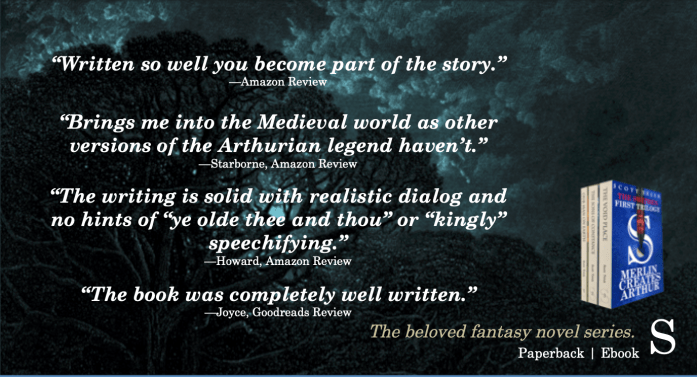
Which means, apparently, that I will be criticized by some. Others, luckily, seem to like it, and I do get appreciative reviews that express happiness at not having to slog through any “Ye olde thee and thou or kingly speechifying,” and what I found quite gratifying to hear: “You almost forget they’re Arthurian characters completely.” So that makes me feel like, at least for some, the approach is working.
How do you handle it, if you write fantasy or sci-fi? And as you read, what do you like to see? Let’s discuss it in the comments.
Facing the challenge of adapting Arthurian materials

Greetings folks! I just published a review of Edward M. Erdelac’s The Knight with Two Swords. I even read it just out of the blue, without trying to get a mutual review scheme going with Erdelac, because… I’m just like that!
Since my own Swithen series of Arthurian novels stays close to the actual Arthurian legends as published, I was curious to see how Erdelac did it. I was also curious to see how he handles the whole Balin & Balan story (Balin & Brulen here), because obviously that episode will be coming up in my own books, and I wanted to be sure that I’m handling it differently. So while the review discusses the book, here I’ll talk about how it approaches writing challenges similar to the ones I face in my series.
As for adapting the actual legend, it was very interesting for me, because he comes at a similar challenge in a somewhat similar way. He fleshes out scenes that we only hear about in the legend—like the Lady of the Lake killing their mother, which, in the actual sources, we only hear about as having happened in the past. Here we have the actual scene, and Erdelac uses dramatized scenes like this to build out his novel. In my own novels I am pressed to do similar things, or to write out scenes that “must have” happened, in order for the work to stand on its own and feel complete as a novel. And in doing so he is able to work in some good Arthur time and a zesty imagining of life amongst the knights, which was both fascinating and entertaining. So it was interesting to see another author handle a similar challenge and realize that it has to be handled in a similar way.
Even more interesting is another challenge of adapting the real legend, which is that the reality of it is quite, quite disparate and does not at all hang together as a cohesive story—because it was not written that way or ever intended that way. In this case, the challenge is to find a way for the Balin story to work on its own, since in the legend it works primarily through eerie resonance with the larger story, and how it creates a symbolic contrast with stuff that happens later in the tale. In my version, those later elements will be there eventually, so I don’t really have to worry about that part, but what we both face as authors is the need to give all of this a larger narrative to fit into, so the entire thing isn’t just some random tale. I have the whole legend, and the luxury of 25 novels, in order to do this (but I’m already WAY worried about it) and Erdelac has to do it here, in this one, and: I have to say that he finds a very nice way to find thematic connecting material that makes the story integral to the overall Arthurian legend, while also remaining faithful to the source material as it exists. Yay, Edward M. Erdelac!
I’m also happy to report that it was different enough from what I intend to do (which is like six novels away anyway… the Balin story will begin in Book 10 or so of The Swithen), that I don’t have to have big worries! So pop on over there and read my review and then buy Erdelac’s book as well as the whole series of my books and leave 5-star, glowing reviews of each one on Amazon—Thanks!