Watch The Swithen video Book Trailers!
Hey there friends, there are book trailers up for Books 1 and 2 now… did you know that? I just posted the one for the second book, and am in final editing for the book trailer for Book 3; The Void Place.
The first one has been performing fairly well and steadily drawing in viewers, which is great. I hadn’t thought about it beforehand–being somewhat thick–but the use of historic illustrations and paintings in these videos has been an invaluable tool to help people understand, and get excited over, what the books are about. They help people visualize the characters of the book, but also have an image of the time period and understand the kind of stories we’re talking about. Here’s the video book trailer for Our Man on Earth:
I was happy to find the cover image of the woman in the cell (above) because it does so much more to create the image of what the book–and it’s main character–is about than any amount of description I could give. Then the images throughout the video give the reader the sense of the tone and setting of the book better, and more convincingly, than anything I could say.
Here’s the actual URL in case the videos don’t embed: https://youtu.be/n12oI4-89Ug
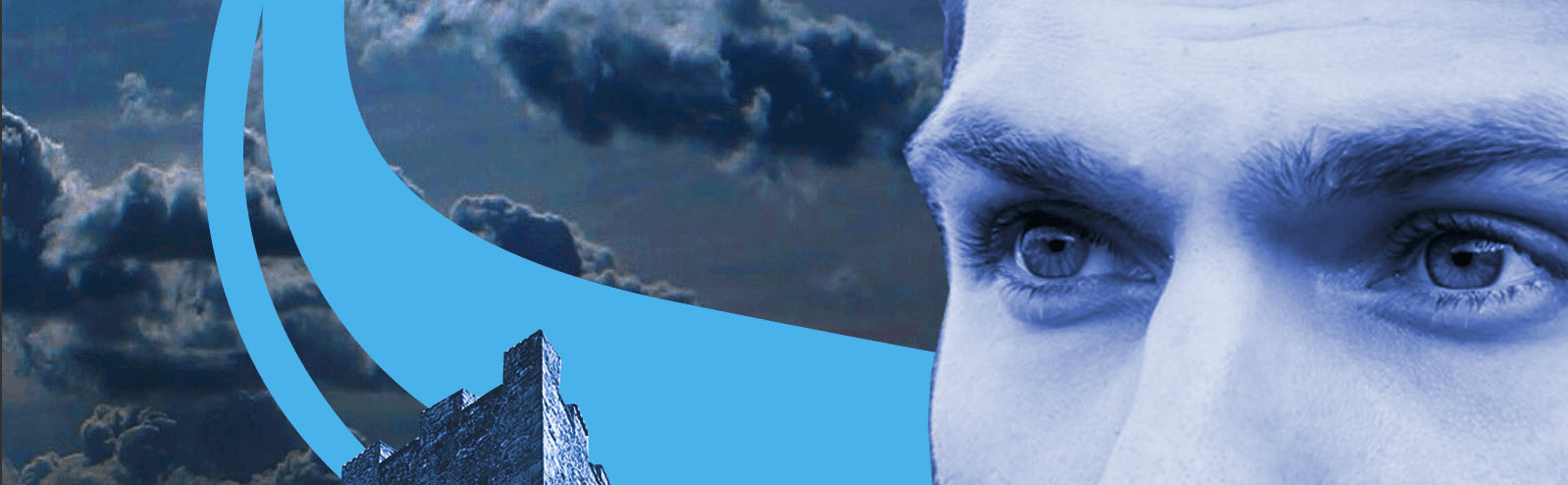
Similarly, the image of the knight there I think does so much more to help potential readers understand the world we’re in than any description I could have given–and ditto all of the other images in the video.
Here’s a URL for the Book 2 trailer: https://youtu.be/QtfpGh-w7YI
What do you think? How do you like the trailers or what do you think about how they came off? Let me know in the comments…
Adapting the Merlin legend into a novel

To draw your attention to another article I just published on the site, I just added a detailed examination of what in the first novel of The Swithen, Our Man on Earth, is from the original legend, and which parts I added. Since the entire series is based on the actual Arthurian legend of 1136 through Thomas Malory’s Le Morte D’Arthur of 1485, every book in my series is going to be, to some degree or other, a development of earlier material. But when readers talk or write me about the books, they often ask “Is THAT in the original legend?” And usually the craziest things about the books are! But anyway, this article is there to sort out what’s embellished by me and what elements are in the original legend.
In this case, pretty much everything about Meylinde, Merlin’s mother, is added by me—including her name. Women have a very interesting place in Arthurian literature… it’s too reductive to say that they are ignored in favor of men, but often the men’s adventures take precedence (although the men do not exactly receive portrayal of their deep thoughts or emotions either). In this case, Merlin is clearly the star and was considered to be the POINT of the whole story, so in the legend, his mother is just “the mother,” and doesn’t ever even receive a name. I also mention in the article that the LONGEST version of her story is 20 pages… from which I wrote my almost 350-page book!
When I wrote the first version of the book, I also thought that everyone would also be just trying to get through the first part and only start paying attention once Merlin is born. At that time, I was also planning to follow the legend exactly and just DROP his mother once he leaves her, the way the legend does. But once I decided I couldn’t dump her, I got a more clear picture of the role she is going to play, I knew I had to go back and beef her up so that the book is really ABOUT her, and then in the second book, Merlin will move more into the fore. This led to my going back and revising the first book so that it really is the story of Meylinde, and she has a much more definite character of her own… she’s no longer just the person who brings Merlin into the world.
Some other quick previews: No one else in her family receives names in the legend, nor do the midwives or the judge… almost all of our main characters! Basically the only people in the novel who get names in the old legend are Merlin and Blaise, the hermit who goes on to write down what, we are told, becomes the record of the Arthurian saga. Oh, and all the stuff about the formation of Merlin’s mind is made up by me as well. But let’s not get ahead of ourselves! Go to the article and find out what about the first novel is actually from the legend, and what’s added.
Let me know your thoughts, too. Those original legends are pretty wild… especially for 1215! Let me know what you think in the comments.
A male author trying write about sexual assault – responsibly
Greetings friends and readers–
I want to give a little more context, and direct readers who haven’t seen it, to the piece I wrote for this site on the process I went through to write about the sexual assault that occurs in The Void Place in a responsible way.
I am a queer cisgender man who is married to a social work professional, so I am constantly surrounded by people who are very highly aware of numerous intersecting social issues and identities. Because of this, when I knew that writing about the crime that occurs when the future King Arthur is conceived, I was, oh, you know–terrified.
If you don’t know [SPOILERS for a story from 1485] the legend is that Merlin disguises the king, Uther, as the husband of Igraine, the woman Uther is obsessed with, and she takes him to bed, where Arthur is conceived. As an additional nightmare, she is then forced to marry her rapist, in order to protect her “honor.” And as the whole point of my series is maintaining strict fidelity to the actual Arthurian legend, I have no leeway to change any of this. So I was in quite a quandary as to how to deal with it in a way that is responsible and accords with my values.
First, we have seen men excoriated for attempting to write women’s perspectives at all, let alone writing about a woman’s perspective on a sexual assault. But as there’s nothing I can do about that, I decided that the way to go forward, and the most honest way to imagine the whole situation, is to go deep into Igraine’s anguish and bewilderment over the situation, her horror at how her happy life has been destroyed, and her ongoing bitterness about it afterward. I also tried to build out her intellect and personality (like most women, she is little more than a symbol in the Middle English sources), and give her a few moments in which she stands up for herself and strongly expresses her own will.
As for preparation, I wrote an article on how I went about preparing to write this aspect of the book (Preview: The main ingredient was reaching out to women for their perspectives), and you can read all about it here. The full link is provided at the bottom of this page.
As I said, I travel in fairly socially-aware circles, and so I was a bit shocked to humbly take it to Facebook and Twitter and find out that not everyone cares–at all. I was met with the comment that “political correctness jumps the shark” (not entirely sure what that means), people who say that it would not fit the legal definition of rape (and WHY are we so worried about what isn’t legally rape?) and, most surreal, a woman excoriating me for trivializing rape by saying that non-violent, but still non-consentual, sexual assault is not rape.
Still, at the bottom of it all, in addition to being responsible to women, I had to be honest to my own feelings as a human, which could not lead me to write it any way other than as a severe bodily invasion and violation, one with indelible, long-lasting consequences. And we will indeed see those consequences play out all the way to the end of the series.
What do you think? Should I have written about it at all? Do you think I handled it adequately? How would you have done it differently? Let me know your thoughts in the comments, and feel free to share this post to generate more discussion.
Plotting out the Swithen series
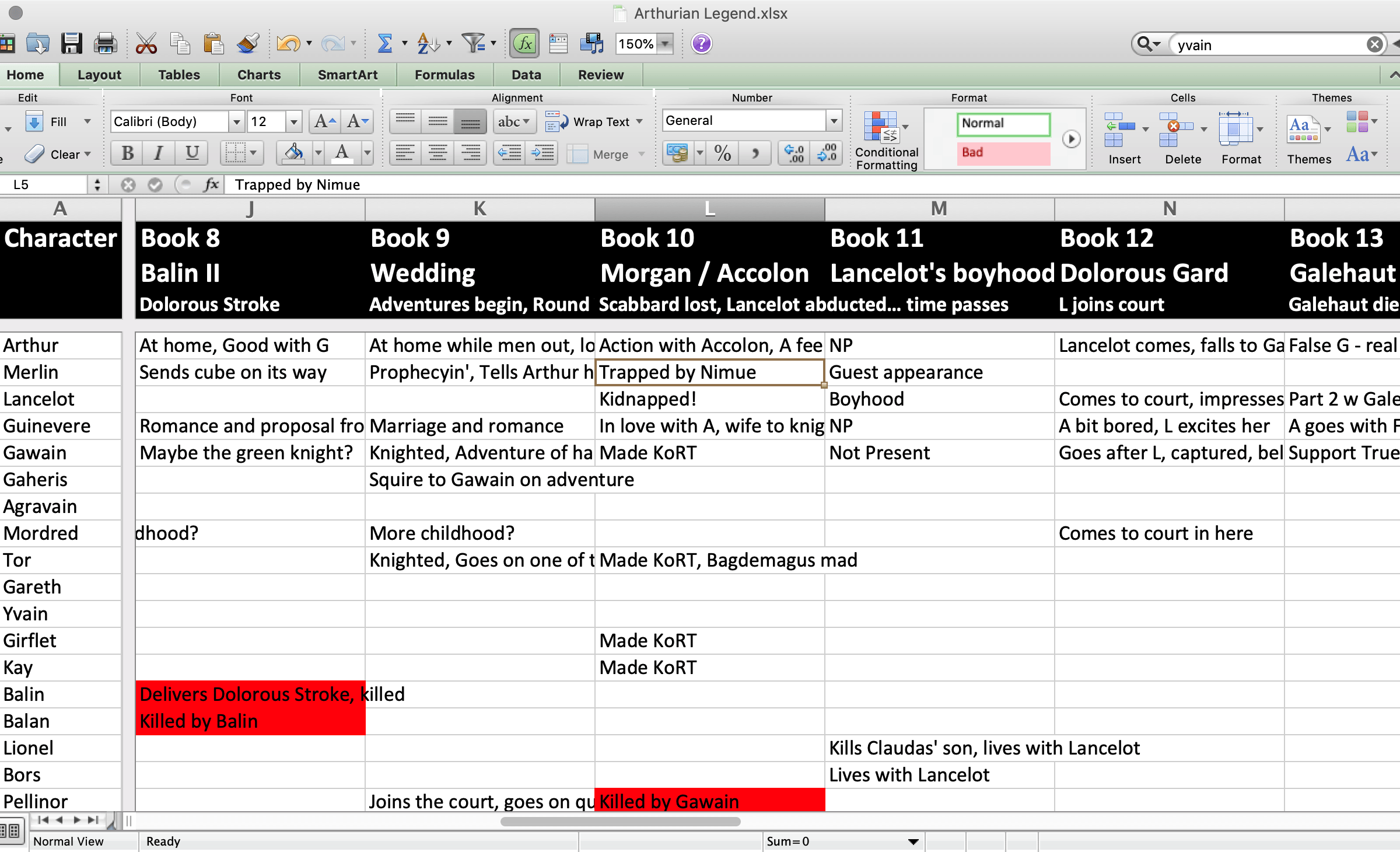
For my first blog post I thought I’d discuss my process for plotting out the interplay of storylines that will flow throughout the series. Below is the spreadsheet I’ve started, and still remains very much a work in progress. Down the left are the names of all the characters. Along the top are the books, extending all the way to 25, the end of my telling. Red indicates when that character dies.

Since Books 4 and 5 will be almost entirely made up by me, this allows me a little time to plot out the rest of the 20 novels that will tell what most of us recognize as the classic Arthurian legend. What I’m doing right now is going through summaries of Le Morte D’Arthur and the Vulgate Cycle and writing down the names of every character that has a part to play that interacts with the others, when they appear, when major events happen, and when they die. This way I can plan the flow of the entire series and have an idea what is coming for each character, so I can start to build toward it in earlier books and form their characters by knowing what is coming for them down the line. This is very helpful to me as I want the series to be very tightly plotted and avoid that nightmare situation where I have to say “Well actually, ten years ago THIS hapened, but I didn’t tell you about it til now because, ummm, well….”
I’ve actually already had that happen where I had to go back to Book 3 and add that Uther conquered King Claudas, because that sets up Claudas’ enduring enmity for the remainder of the series… and it’s situations like that I want to avoid.
This is actually just one tab of a huge overall spreadsheet… I have one for each book, one plotting the new characters I’ve introduced, and one, largely unfinished as of yet, that gives the ages and mental/emotional state of every character as they move through the series. This one will really help me with that one, as I need to have a big overview of all the plot events and what happens when to begin to more specifically imagine the life stages of our characters as they experience these events, and live with each other for decades, find themselves aging and their perspectives on life changing.
 The Swithen