Book Review: Then Arthur Fought by Howard M. Wiseman
The “history” that was reworked into the Arthurian Legend
When this book was released, I loved the cover but didn’t think it was for me. This is a “history” of the early Britons, largely centering on King Arthur, but also including his forebears and descendants. The reason the word “history” is in quotes is that the final work is defined by the author as a “quasi-history,” which means that Wiseman took numerous chronicles including Geoffery (itself unreliable as history and largely fiction), developed a criteria of reliability (older vs. newer, Welsh vs. from elsewhere), and made a lot of informed decisions to hammer it all into a plausible narrative. The result is a curated synthesis of numerous chronicles, legends and his own fiction to create one cohesive and plausible narrative.
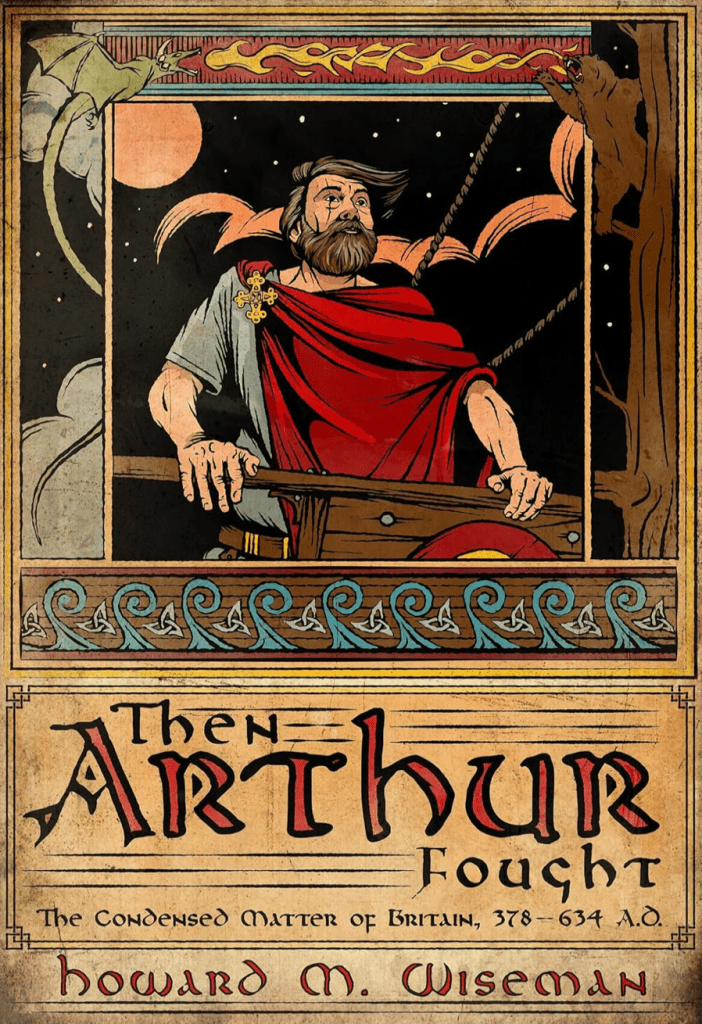
When it was released, I was still involved in getting through the major works of Arthurian literature and wasn’t very interested in whether Arthur actually existed or not, so it seemed irrelevant. This book has shown me that far from being unrelated, the history has a great and very interesting relationship to the literature that illuminates it in a way I hadn’t anticipated.
Howard Wiseman is a professor of theoretical quantum physics and also an amateur Arthurian scholar. Knowing the ways in which complex minds are drawn to and ensnared by the endless mysteries of the Arthurian legend, one is thankful that it captured the interest of a theoretical scientist with the imagination and precision of mind that allowed him to write this book! It requires the ability to sift through an overwhelming amount of historical chronicle and the imagination to fill in the gaps with his own fiction in order to create a readable and engaging narrative.
I personally don’t get far with reading straight history with its “then this happened, then that happened, then this other thing happened” structure, but Wiseman is able to pepper his narrative with enough juicy quotes and vivid scenes that it gains enough traction to be readable and engaging. He also employs an ingenious color-coding system for the maps that begin each chapter, showing who held which territory when, also coding the color of the names as they appear in the text so a reader can easily match them to the map.
What surprised me most was how interesting it was when considered against the fictional stories that have grown up around these figures. I had thought the history and the legends would be two vaguely-related but largely separate things, but I was wrong. In this narrative we glimpse what might be early appearances of characters and events that made their way into the Arthurian literature, keeping in mind that the author made several educated decisions about who and what to include or leave out in order to craft a plausible, readable ‘history.’

For example, in this version, Uthyr is the “Pendreic” [“head dragon”] of his people, making it easy to see how that may have evolved into the “Uther Pendragon” we are familiar with. Uthyr is fascinated by his brother’s wife, and asks his wizard Menio to come up with a plan to have her. He wears his brother’s clothes to enter the castle “Dundagel” and make love with her, producing Arthur. One can easily recognize how this story evolved into the version in the legend, where Merlin changes Uther into the appearance of his ally’s husband to enter the castle at Tintagel.
Another clear transformation of tale into legend is that Arthur is supposed to have a coat lined with the beards of his enemies, which is ironic because he himself barely has a beard at his young age. One can recognize the element of the legend where King Reince has a mantle lined with his enemies’ beards, and Arthur says his own beard wouldn’t do for it, because he is too young. In this book one can see echoes of the figures and incidents that were woven into the legend.
Having just rewritten the first novel of my series to include Vortigern based on Wace and Laymon, I was fascinated by the pre-Arthur history that included the usurper king as well as Hengist, Rowena, Horsa and Vortigern’s son Vortimer. Having a favorite character in Ulfius (AKA “Ulfin”), Uther’s best friend, I was pleased to see his appearance as a (possibly) real person in the guise of “Ulfwine.” Later, Arthur entrusts his kingdom to his nephew “Modraut,” who attempts to take his throne and the queen. You will recognize legendary figures like Arthur’s wife “Guenhuvar,” Archbishop Dubricius, Arthur’s seat of rule in “Camulod,” and his nephew “Gualwain.” There is a third section that continues the story after Arthur’s death, where I was surprised to see that Beowulf exists in this reality, and also “Drustan” and “Eisyllt.”
Ultimately this book is like an updated version of Geoffery of Monmouth’s History of the Kings of Britain. It includes that book and many other sources and chronicles to deliver a more complete picture of the Matter of Britain, synthesized and made accessible for the average reader. Any Arthurian enthusiast, whether of the history or legend, will find a great deal of insight and entertainment here.
Find Then Arthur Fought at Amazon > > >
 The Swithen