Swithen FAQ
Find answers to your most-asked questions about The Swithen book series.
What is The Swithen?
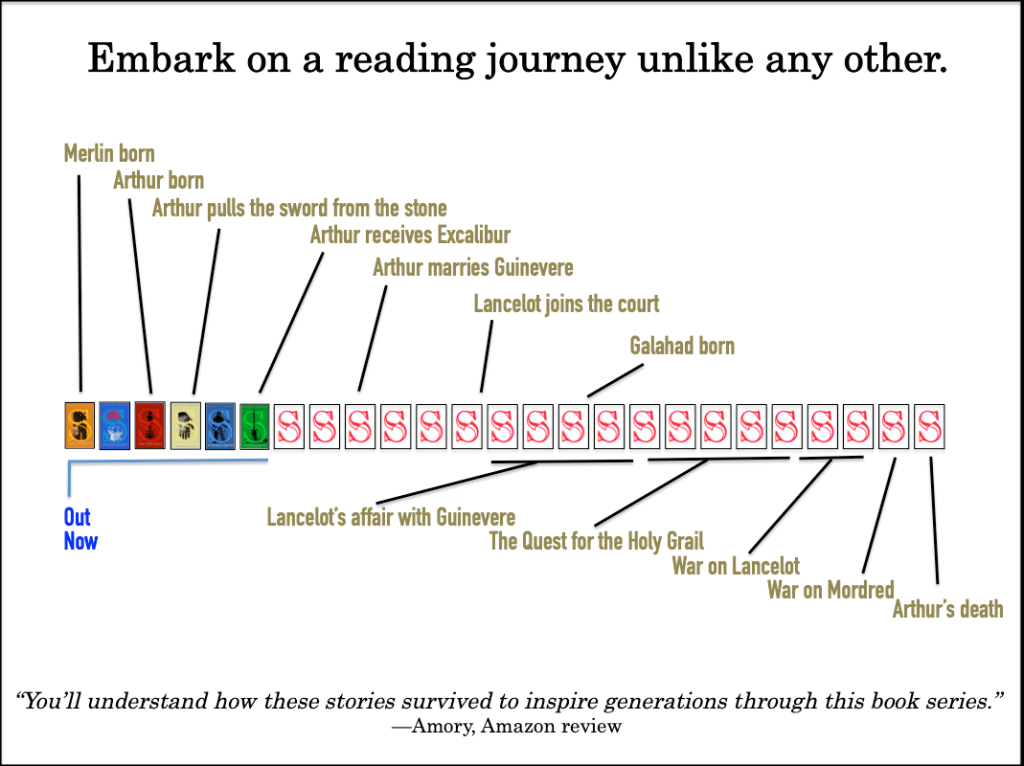
The Swithen is a series of novels that retells the medieval Arthurian legend as laid down between the years of 1136-1485 with absolute faithfulness to the source material. Twenty-five novels are planned to tell the full Arthurian saga, and six of those are finished and out right now. They take us from the birth of Merlin up until King Arthur’s first years of rule. Scott Telek is at work on the seventh installment now.
What is the significance of the 1136-1485 time frame?
This is period in which the classic Arthurian legend as we know it came to be. The first chronicle that included King Arthur was published in 1136, and Sir Thomas Malory’s Le Morte d’Arthur can be considered the end of the main period in which the legend was developed. The idea is to avoid some of the wild flights of fancy that overtook certain Arthurian works that came in later years and deliver an experience that conveys the weirdness and poetic ironies of the legendary material.
How does The Swithen differ from most Arthurian fiction?
Where the majority of contemporary Arthurian fiction invents new stories, or new characters that take place in the world of the original tales, The Swithen tells the original stories of King Arthur and his associates, set down between the 11th-15th centuries, in a way that is engaging and gripping for modern readers. You will discover the authentic Arthurian legend by reading this book series.
Why does it need to be so long?
The Arthurian legend is an epic in the true sense of the word. It covers three generations over a span of about seventy years. It is a series of small stories that make up one huge story. The most popular telling, Malory’s Le Morte d’Arthur,moves so quickly that the events don’t strike with the impact they deserve. The Swithen is an attempt to translate the tale for a modern audience, so that all the smaller stories make sense and have emotional impact, leading up to a larger narrative of unparalleled scope and power.
What does your interpretation offer?
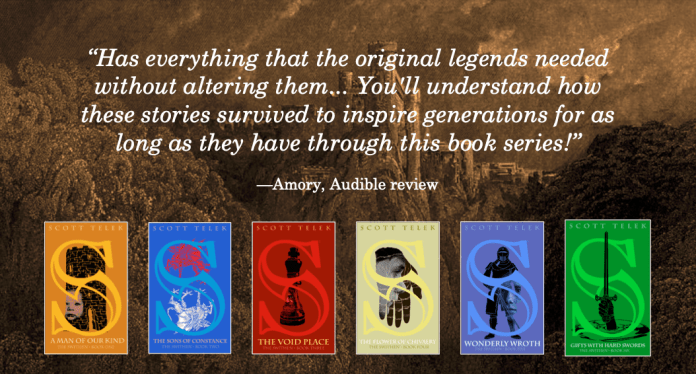
The original works are written in Middle English, which does not offer much in the way of psychology or characterization, are missing crucial connecting elements, making the original legend difficult to read. The Swithenadds in psychology, attempting to make the characters real people with relatable failings and strengths. It adds in connecting scenes and arranges elements to make the story fit together into a readable narrative, writing in the past of each character when they may just appear without introduction in the sources. It also helps us understand the complex family relationships that are an important part of understanding the story as a whole. It marries the disconnected narrative into a cohesive whole and generally, as one reviewer put it, “makes the Arthurian legend readable and relatable for us.”
I like to wait for a series to be complete before I read it.
Understandable! But it will be at least twenty years before the full series is completed. Instead, it is best to look at the books as similar to a television or comic book series; installments that build on each other and grow over time. The story advances with each book, and each novel does come to a satisfying ending, while the next installment grows the characters and advances the story. The first three books all have different main characters, and some of the books further on will focus on one character while others fade into the background. Because the entire thing is based on Medieval stories, the typical three-act structure is not in play and the stories move in unexpected directions.
What a original and what is new?
As a general rule, what happens in the books is usually from the legend. How the characters think and feel about it has been added. The novels follow the events of the legend, but sometimes elements are added in order to make the story into a cohesive whole and to make the entire tale consistent. But anything that is added must fit into the original legend without changing it. At the end of each book is an appendix that discusses what elements are from the original legend and what has been added. You can also find those pieces on this site, called “Legend to Novel” for each book. For more detail, please see The Rules of The Swithen.
Why do these stories need to be retold?
These stories have lasted centuries and inspired some of our most popular and enduring pieces of poetry, art, literature and popular entertainment. For that reason, many of us feel that we know the stories and that they have passed into cliché. Not entirely true. There are a great many elements that are not known, and since the entire saga is too long and epic to be contained in any one book, movie or even TV series, the relationship of all the stories within the saga are rarely depicted. The Arthurian legend centers on moral conundrums and the struggle to be an admirable person in a world of dubious morality, and as such the questions it prompts us to explore are endlessly relevant.
What are the sources of The Swithen?
The Swithen draws on Thomas Malory’s Le Morte D’Arthur of 1485, the Prose Merlin of approximately 1450, the Prose Lancelot (or Vulgate and post-Vulgate Cycle) of 1215, Chretin de Troyes Arthurian Romances of 1177 and Geoffery of Monmoth’s History of the Kings of Britain, written in 1136, as well as associated side stories, such as Sir Gawain and the Green Knight, of the late 14th century.
What is a “Swithen?”
“Swithen” is a word from Old Norse that means “burning,” and is an agricultural term that refers to the act of burning a field in order to clear it and make it fertile for a new harvest of crops. One large theme of the Arthurian legend is the succession of passing generations, and one of the biggest transitions is the quest for the Holy Grail. The name has been chosen mostly to express the civilizational upheaval to the Arthurian world presented by that quest and its aftermath.
What works has King Arthur inspired?
Anything with a “chosen one,” a legendary weapon, a wizard, or largely concerned with warring factions of warriors, kings, queens and wizards or sorcerers, has its roots in King Arthur and his legend. Therefore, Star Wars, Lord of the Rings, Harry Potter and Game of Thrones are just a few of the popular entertainments that have their roots in Arthurian legend.
 The Swithen