Guide to King Arthur Movies
You want to watch a King Arthur movie! There has to be a good one, right? Well, not really, for reasons detailed in my article and video: Why There Are No Good King Arthur Movies.
Short version: It’s too weird, too big and too long to make into a decent movie. But a few have tried, and here they are! Below we’ll discuss some of the more prominent King Arthur movies and what’s special about each one.
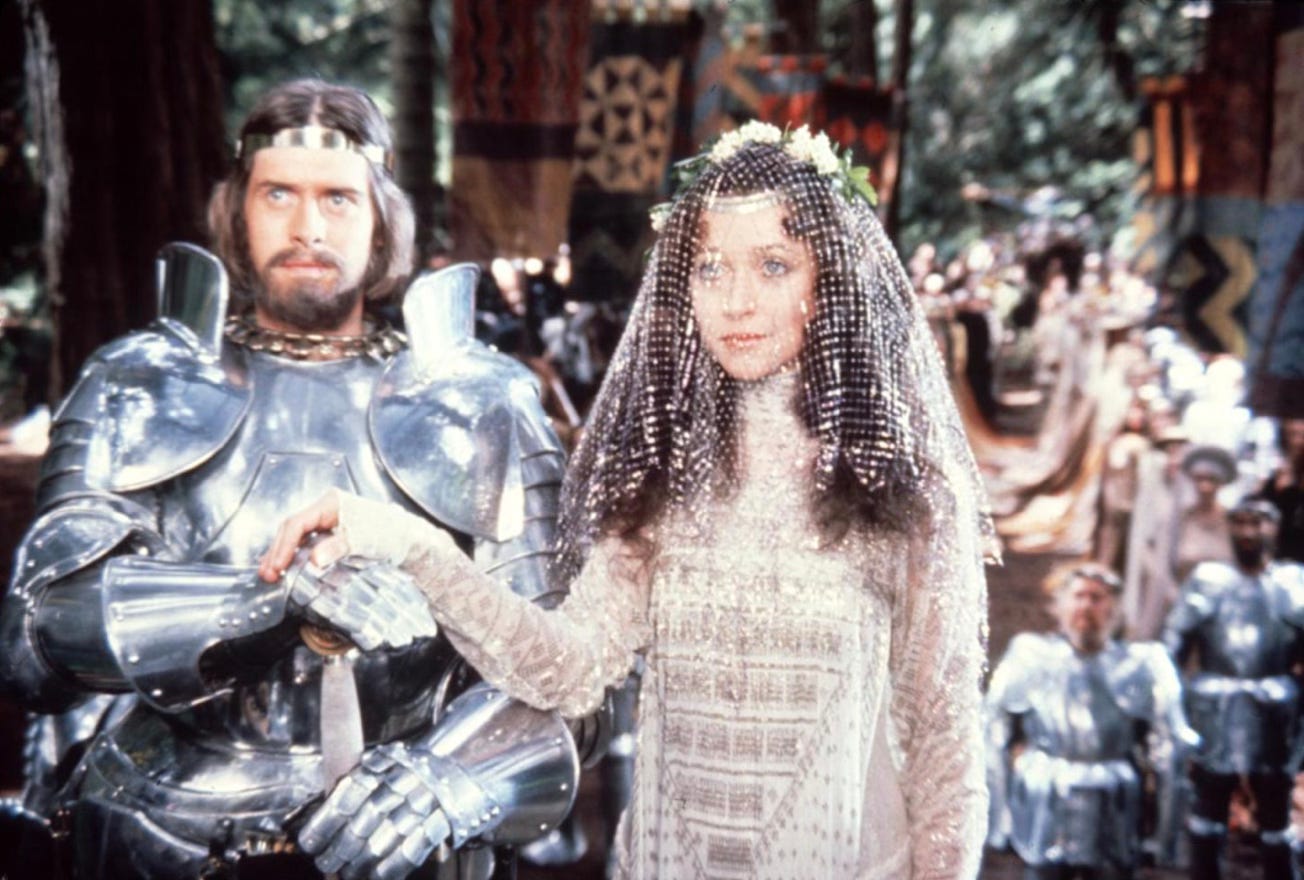
Excalibur (1981) by John Boorman
This is probably the best all-round King Arthur movie and will give you a basic outline of the overall story. It brings to life visions that express how many of us imagine the Arthurian world and captures the atmosphere evoked by the saga. The problem is that they have about sixty years of dense, very complicated saga to cram into two hours, and that just isn’t enough time, losing a lot of the richness in the process. But if you want to watch a King Arthur movie, this is it, and it will show you beautiful visions and excite you over the power and beauty inherent in the legend.
King Arthur: Legend of the Sword (2017) by Guy Ritchie
I had a great time at this movie, but you have to understand that this has nothing whatsoever to do with the King Arthur of the legends. It’s trying hard to be “not your father’s King Arthur” and it succeeds—it’s not King Arthur at all. It’s a medieval mish-mash with some familiar names. It’s silly fun but it could as easily have been King Josh or King Tony.
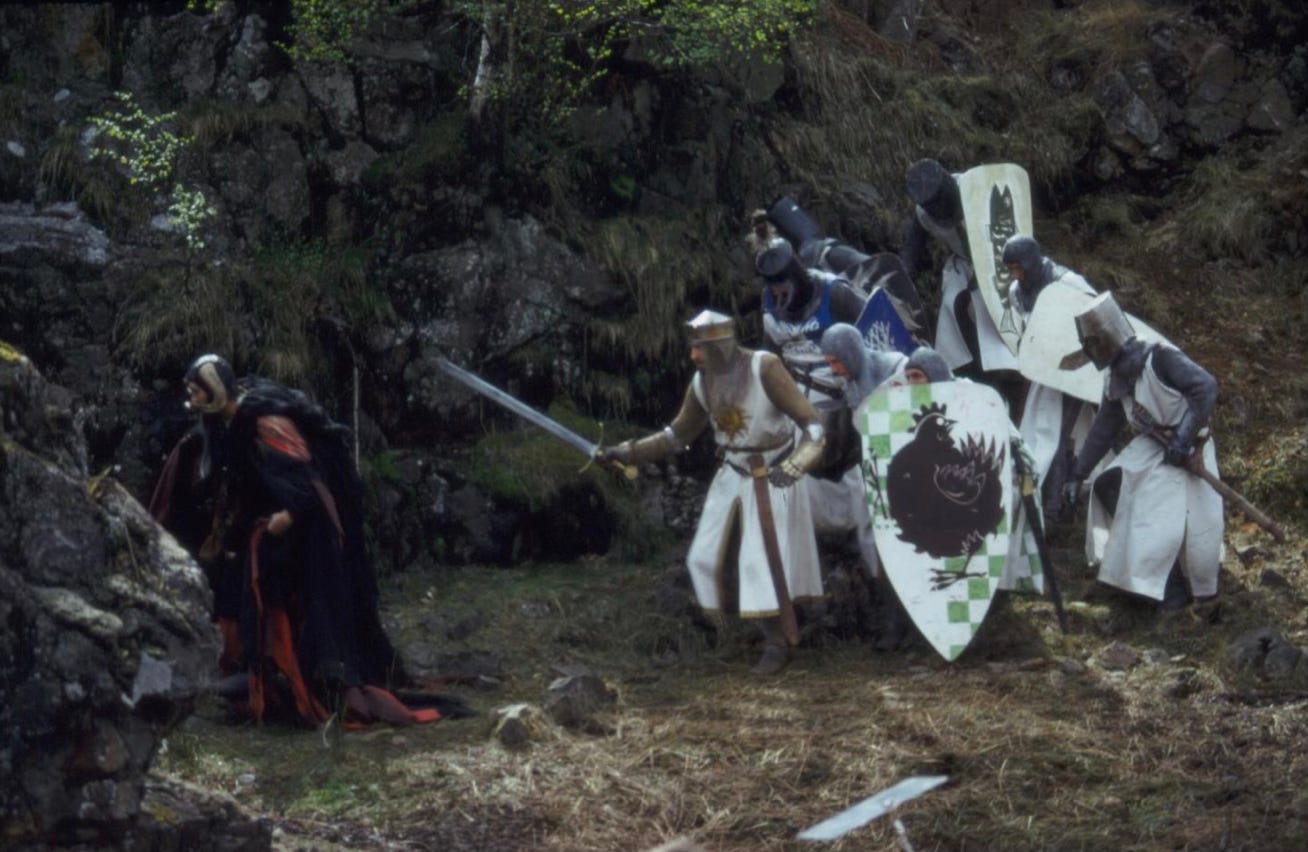
Monty Python and the Holy Grail (1975) by Terry Gilliam and Terry Jones
You might be surprised to find this at the top of the list of most successful King Arthur adaptations. It is, mostly because the others are so dreadful, and because it is generally referring to real aspects of the legend, and it is made out of deep veneration for the material, even as it is mocking it. Elements like the knights who say ‘Ni,’ the knight still itching to fight after he has been hacked to pieces, even the killer rabbit are just extreme exaggerations of material found in the actual legend. This is also one of the few adaptations to acknowledge that medieval life was dirty and generally unpleasant and unorganized.
Camelot (1967) by Joshua Logan
The first thing to understand is that this is adapted from T.H. White’s The Once and Future King, not from the Arthurian legend itself. As such, it is primarily concerned with the love triangle of Arthur, Guinevere and Lancelot, which lends itself best to love songs, and tries to abruptly snap back into the larger scope of the story at the last minute—and doesn’t quite succeed, if you ask me. But it does capture a certain strain of the grandeur of Arthur and Guinevere as king and queen and Camelot as an exalted period of imaginary history.

The Green Knight (2021) by David Lowery
This is an adaptation of the poem Sir Gawain and the Green Knight which is a separate Arthurian work, not fully integrated with the storyline of the best-known Arthurian saga. It takes enough liberties with the story and the character of Sir Gawain that I can’t really get behind it as an adaptation. It does follow the basic plot beats of the poem, but with characters that do not match their legendary counterparts and a conclusion I don’t think is supported by the source poem. But many people like it and it does have a great look and surreal, dreamlike vibe.
First Knight (1995) by Jerry Zucker
This movie has kind of an idea, which is to have an Arthurian film free of magic (hence, no Merlin at all) and concerned with the love triangle aspect. It also focuses on the situation of Guinevere being kidnapped and Lancelot rescuing her, which is very present in the legend. You can’t ask for a much better King Arthur than Sean Connery, but Richard Gere’s Lancelot is just smug and vain. He’s also a mercenary with no ideals, the very opposite of what the very value-oriented Lancelot is in the legend. And the Knights of the Round Table are portrayed as a bunch of bumbling idiots, which is not the case. Still, you could do worse, and it’s not completely far off from the ideals of the legend. And Camelot looks great.
The Sword in the Stone [Disney] (1963) by Wolfgang Reitherman
Another adaptation of T.H. White’s The Once and Future King (i.e. not the actual legend) this movie covers that collection’s first novella. This is where most of us get the misconception that Merlin is with Arthur during his childhood, which is not in the legend (although no information about Arthur’s childhood is in the legend at all). This movie is cute, light and fun, with Merlin changing Arthur into various animals in order for him to learn life lessons. Its values kind of match up with the larger legend, but the particulars of the story are not from the legend.
King Arthur (2004) by Antoine Fuqua
This is said to be a more realistic depiction of not the legend, but the actual history that went on to inspire the legend. It is produced by Jerry Bruckheimer (Top Gun, Con Air, Pirates of the Caribbean) and directed by Antione Fuqua (Training Day). Arthur is a warrior and so is Guinevere, and Lancelot and Merlin are on hand.
Knights of the Round Table (1953) by Richard Thorpe
I only made it halfway through this movie before I couldn’t deal anymore, but if you want the classic, 1920s-1950s style King Arthur with noble nights and trumpet flourishes and bright colors where everyone is tripping over themselves to be nobler still than their already-noble companions, this is it. Several people like it and it is the epitome of a certain view of the legend.
Lancelot du Lac (1974) by Robert Bresson
For those who like it arty, this film gets something about the Arthurian legend that others don’t. It focuses on the period after the Grail Quest when the court is at a low point. Lancelot and Guinevere’s romance has taken on a desperate atmosphere, and in this environment Mordred schemes to expose them. Very slow-moving and languid, not for the casual viewer, but this movie captures a certain bleakness and groaning desperation of the Arthurian legend better than any other.
 The Swithen