Le Morte d’Arthur Guided Reading 4: Book 1, Chapter 2
.
We’r continuing our guided reading of Sir Thomas Malory’s Le Morte d’Arthur with Book 1, Chapter 2. Uther wants Igraine and his buddy Ulfius just rode out to find Merlin to help him. So let’s get started!
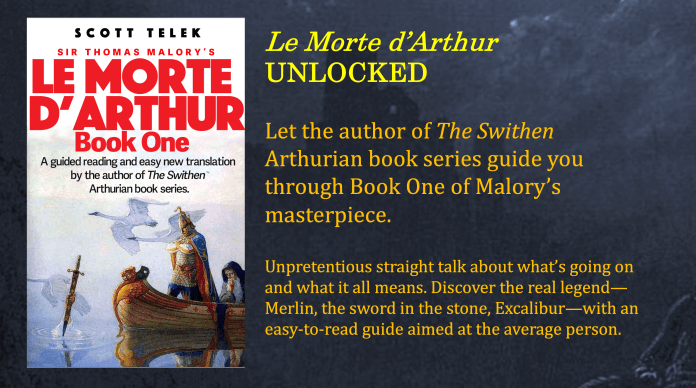
Just a reminder, the full text of this entire guided reading plus the introduction and bonus material is available as a companion ebook or paperback.
Companion book:
Then Ulfius was glad and rode on more than a pace until he came to King Uther Pendragon and told him he had met with Merlin.
“Where is he?” said the king.
“Sir,” said Ulfius, “he will not dwell long away.”
Therewithal Ulfius was aware that Merlin stood at the porch of the pavilion’s door, and then Merlin was bound to come to the king. When King Uther saw him, he said he was welcome.
“Sir,” said Merlin, “I know all your heart’s every deal. So you will be sworn unto me as you be a true king anointed, to fulfill my desire, you shall have your desire.”
Then the king was sworn upon the four Evangelists.
“Sire,” said Merlin, “this is my desire. The first night that you lie by Igraine you shall beget a child on her. When that is born, it shall be delivered to me for to nourish as I will have it. For it shall be your worship, and the child’s avail, as much as the child is worth.”
“I will well,” said the king, “as you will have it.”
Malory makes a major change here, again with the result of rendering Merlin a little more likable and less complicated. In the Vulgate, Merlin doesn’t tell Uther he is creating a child until after he has done it. He makes Uther promise to “give me what I ask for” but doesn’t tell him what it is. This is a thing that happens a lot in the Arthurian legend, and it is referred to as a “rash boon.” That is, the characters make a rash promise without fully knowing the terms of the agreement. So in the Vulgate, it’s like, “Hey, wild time last night! Guess what, you made a baby, and that is what you owe me as the price of your night of pleasure.”
For Le Morte d’Arthur, Malory changed that so Merlin tells him up front that he is going to make a baby and that this baby is what Uther will owe to him. So it’s a bit more forthright and honest. For my retelling in The Void Place, I kept it that Merlin doesn’t tell him until afterward, because I like it dark and complicated! By the way, in the Vulgate, Merlin tells Uther that he cannot even see the child and “never know him,” which implies that he finds something about Uther to be a little wrong and distasteful. As I told you, in the Vulgate, there is a lot of unspoken tension between Uther and Merlin.
“Now make you ready,” said Merlin, “this night you shall lie with Igraine in the castle of Tintagel, and you shall be like the duke, her husband. Ulfius shall be like Sir Brastias, a knight of the duke’s, and I will be like Sir Jordanus, a knight of the duke’s. But I warn you make not many questions with her nor her men, but say you are diseased and so hurry you to bed and rise not on the morn till I come to you, for the castle of Tintagel is but ten mile hence.”
So this was done as they devised. But the Duke of Tintagel saw how the king rode from the siege of Terrabil, and therefore that night he issued out of the castle at a postern for to have distressed the king’s host. And so through his own issue, the duke himself was slain before ever the king came to the castle of Tintagel.
After the death of the duke, King Uther lay with Igraine more than three hours after his death and begat on her that night Arthur. When day came, Merlin came to the king and bade him make him ready, so he kissed the lady Igraine and departed in all haste. But when the lady heard tell of the duke her husband, that by all record was dead before King Uther came to her, then she marveled who it might be that lay with her in likeness of her lord. So she mourned privately and held her peace.
So Merlin changes Uther’s appearance to look like Igraine’s husband, the duke. Ulfius looks like Brastias, and Merlin looks like Jordanus, who is around, but a bit of a nothing. Brastias is one of those characters who is always around but we only hear about so often. He is a much more fleshed-out character in the Vulgate, where he and Ulfius end up becoming buddies. The traces of that are still here. This whole thing leads to a new story I explored in Book Five of my series, called Wonderly Wroth, in which Brastias finds out years later that his good buddy Ulfius impersonated him and is not at all happy about it because it ruined his happy life with Igraine and the duke.
Now, when Uther goes out for the night, the duke sees that, and uses that opportunity to attack, and he gets killed. And he dies three hours before Uther went to Igraine. So she has to wonder who was with her, and the text tells us that she “mourned privately and held her peace.”
Okay, so let’s think about this; Uther, this guy Igraine hates, is going to disguise himself as her husband and have sex with her under false circumstances—is that really cool? Is that something we would condone today? It’s pretty nasty in my book—and it’s only about to get worse for Igraine.
Secondly, what is this thing about the duke dying three hours before Uther goes to Igraine? That’s just one of those mysterious things that makes the legend interesting and, even if we don’t know what it means, it’s just spooky and evocative. It also lets Igraine know for sure that the guy who was with her was not her husband.

Now finally, most of us have the idea that medieval times were not a period of great freedom and liberation for women. A lot of times in the larger legend, we have the legend explicitly tell us one thing while the details it offers say another thing. For example, it will tell us that Uther and Merlin “had great love for each other,” and yet not long after this point Merlin refuses to speak to Uther and is pretty tetchy with him when he does. Similarly, it’s worth focusing on these few hints we get about what Igraine might be feeling.
So she just found out her husband is dead. She just realized that someone, or some thing, just had sex with her under false circumstances, and she doesn’t yet know that she is pregnant with that… whoever it was. So it says that she “mourned privately and held her peace.” What is it saying here? So stayed quiet and didn’t bother anyone? And that’s good? Kind of sounds like that’s what it’s saying.
Now, I often say that one of the most interesting things about Le Morte d’Arthur is the thoughts and questions it causes you to have, and some of those we might consider here are; how much is Merlin actually controlling all of this? In the Vulgate Cycle, Merlin knows that he’s going to create Arthur by the time he is about a year old. So how much is he actually masterminding all of this? And why do Uther and Igraine end up being King Arthur’s parents? Oops, hope it’s not a spoiler that the baby is King Arthur! So it makes sense that Uther is his father, because once their lineage is established, Arthur will automatically be king. But why Igraine? Why does it have to be this woman who is married to someone else? Why does Arthur have to be born of this deception and this lust of his father’s? I don’t necessarily know the answers, but these are the kind of questions it’s interesting to ask.
Then all the barons by one assent prayed the king of accord between the lady Igraine and him. The king gave them leave, for fain would he have been accorded with her. The king put all the trust in Ulfius to entreat between them, so at the last the king and she met together.
“Now will we do well,” said Ulfius. “Our king is a lusty knight and wifeless, and my lady Igraine is a passing fair lady. It were great joy unto us all and it might please the king to make her his queen.” Unto that they all well accorded and moved it to the king. And anon like a lusty knight he assented thereto with good will, and so in all haste they were married in a morning with great mirth and joy.
So here, the barons—which is another way of saying the important people in Uther’s court—have the idea that Uther should marry Igraine, and Uther, being a “lusty knight,” wholeheartedly agrees. In the Vulgate Cycle, Uther’s friend Ulfius is a much bigger and more influential character than he is in Le Morte d’Arthur. Remember Uther had Ulfius go court Igraine for him. It was Ulfius who suggested that Uther reach out to Merlin for help. And in the Vulgate, it is Ulfius who suggests to the barons that Uther could marry Igraine. It’s his idea, making him a very, very influential character.
Now, they also characterize this as making repentance to Igraine because now she is without a husband but is pregnant, and you recall within the story (from the tale of Merlin’s mother) that an illegitimate child at that time means burning at the stake. Her daughters, Morgan, Margawse and the mysterious Elaine, will also be considered fallen and will never be able to marry well. You will notice that here in Le Morte d’Arthur, we don’t hear a thing about Igraine’s reaction, but in the Vulgate, it’s one of those contradictory things where we hear that she breaks down weeping but at the same time is said to be thrilled to be marrying the king and becoming the high queen. Yeah, sure, her husband was killed and she is now forced to marry the man who deceived her into sex, but now she’s the queen, so who cares? I am being sarcastic, if you can’t tell.
I also have to say that for my own novel that covers this story, The Void Place, I had a hell of a time with how to remain faithful to the medieval story, as my series is committed to being, and also make this even semi-palatable to readers of today. Especially because our main characters, and our hero in Merlin, are the ones doing these awful things. And the way I handled it was to focus on Igraine’s feelings and the torment she goes through, showing that the whole experience is not nice in any way. And I shifted the majority of the blame to Merlin. He can take it because in my series he is still young at this point and I am a lot more free with him being a very ambiguous character, not entirely the nice kindly old man we’re used to. I also show the daughters, Morgan and Margawse, because they would be there at the time, even if they are not mentioned, and having them around for this helps set up the history for what will happen down the line, most notably Morgan le Fay’s ongoing hatred of Arthur. Okay, so speaking of the sisters, let’s continue.
And King Lot of Lothian and of Orkney then wedded Margawse that was Gawain’s mother, and King Nentres of the land of Garlot wedded Elaine. All this was done at the request of King Uther. And the third sister, Morgan le Fay, was put to school in a nunnery, and there she learned so much that she was a great clerk of necromancy. And after she was wedded to king Uriens of the land of Gore that was Sir Yvain le Blanchemains father.
So Margawse married King Lot, who goes on to be a fairly important character, and they give birth to some very important characters, namely Sir Gawain, who goes on to become Arthur’s best friend, as well as his brothers Agravain, Gaheris and Gareth. Margawse is also the mother of Mordred, who we’ll hear about shortly. Morgan is too young to marry, so she goes into a nunnery and that’s where she learns magic—when they say necromancy, they mean magic—and she emerges as the sorceress Morgan le Fay. She marries King Uriens, and they have a child in Yvain.
Now, what of this other daughter, Elaine? She is never mentioned again. So you have to keep in mind as we go through this that it is still quite loose, and there are a fair amount of things that just plain don’t make sense.
 The Swithen