Le Morte d’Arthur Guided Reading 7: Book 1, Chapter 6
Let’s continue our reading of Sir Thomas malory’s Le Morte d’Arthur with chapter 6, in which Arthur’s family makes known that he has been able to pull the sword and we get some implications about his brother Kay.
“Now try,” said Sir Ector unto Kay. And anon he pulled at the sword with all his might, but it would not be.
“Now shall you try,” said Sir Ector to Arthur.
“I will well,” said Arthur, and pulled it out easily.
Therewithal Sir Ector kneeled down to the earth, and Sir Kay.
“Alas,” said Arthur, “my own dear father and brother, why kneel you to me?”
“No, no, my lord Arthur, it is not so. I was never your father nor of your blood, but I know well you are of a higher blood than I thought you were.” And then Sir Ector told him all how he was betaken for him for to nourish him, and by whose commandment and by Merlin’s deliverance.
Then Arthur made great dole when he understood that Sir Ector was not his father.
Okay, so Ector and Kay cannot pull the sword, but Arthur can. Then they kneel to him, and Arthur asks, “Why are you kneeling to me?” Sir Ector reveals that Arthur is not his son but is of much higher blood. At that time they believed that your blood was a thing, like there was royal blood, and those people truly were genetically superior to people born to those of lower status. And we’ll hear this again when people complain that Arthur is not high-born or of higher blood.
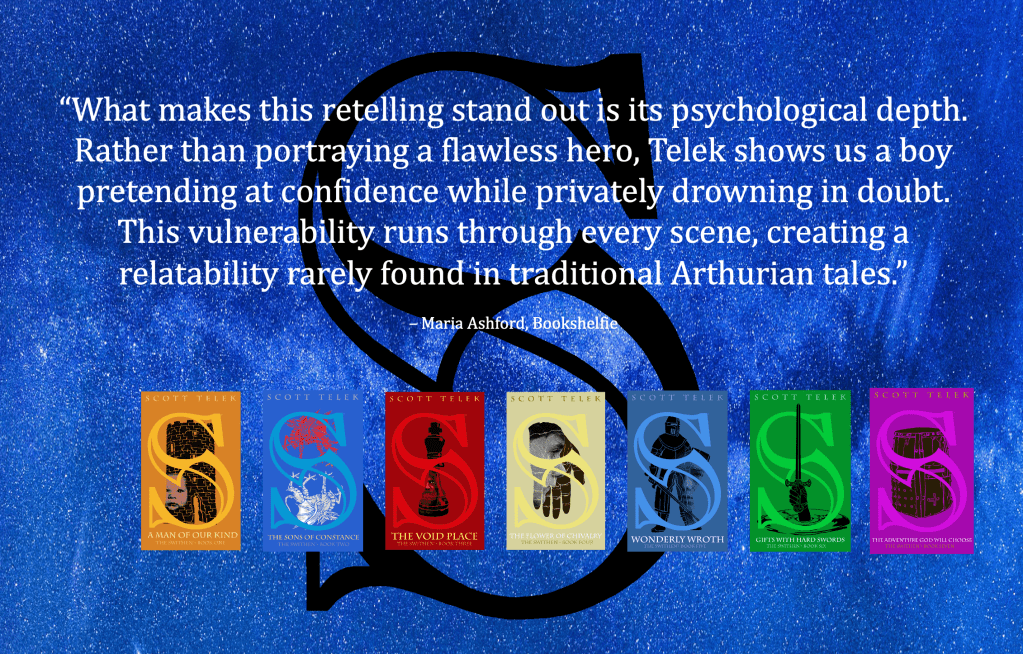
But let’s slow down and think about what is happening here emotionally. Arthur just found out that he is adopted. The man and woman who raised him are not his father and mother—but he doesn’t know who is. So when I was writing my novel about Arthur’s childhood, and I was tasked with coming up with a different angle on him pulling the sword from the stone, something that we’ve seen depicted thousands of times, this is what I focused on; that he has just found out that he is adopted. And I thought; what might Arthur’s emotional reality be in that moment? This sort of abstract idea that suddenly he is the king? Something he has never even considered once in his life? Or would his main feeling center on the fact that he doesn’t know who his family is? And in fact, the people he thought were his parents were lying to him that whole time. And in Le Morte d’Arthur, it says that Arthur “made great dole when he found out that Sir Ector was not his father.” Dole is sadness, like a doleful look or something like that. A lot of the time in the text, they will discuss something being dolorous—like the dolorous stroke coming up—or that someone made “great dole out of measure,” which just means that they were so sad it could not be measured.
Now let’s think about Kay. First of all, remember that Kay’s own mother, at Merlin’s command, put him to a wet-nurse so she herself could nurse Arthur. Back then, they believed that this stuff was much more important than we do today, so in this case, Arthur gets the good milk, and Kay gets the crappy wet-nurse milk, and it was thought that this would really determine your character. But even today we know that a baby nursing from its mother creates an unshakable bond and helps the child form attachment. Kay did not get that attachment to his mother—Arthur got it instead of him. Then they grow up, and now Kay’s just an also-ran while Arthur gets to be king. And don’t forget that great moment when Kay, for a moment, claims that he pulled the sword instead of Arthur. Later on, Kay turns out to be a bitter and sarcastic character—could some of that be caused by the way he is treated here? Kind of seems like it. He’s always next to Arthur, yet Arthur is always better than him. Likely to cause some resentment.
Now who is the missing person in all of this? Arthur’s surrogate mother, Lady Ector! She’s just nowhere to be found, except in one mention below. Such an important person… she is the one who raised the king, and yet she is given no space and not even granted a name. When people say that the Arthurian legend is not the most feminist work that has ever been created, this is the kind of thing they’re talking about.
Okay, let’s get back at it!
“Sir,” said Ector unto Arthur, “will you be my good and gracious lord when you are king?”
“Else were I to blame,” said Arthur, “for you are the man in the world that I am most beholden to, and my good lady and mother, your wife, that as well as her own has fostered me and kept. And if ever it be God’s will that I be king as you say, you shall desire of me what I may do and I shall not fail you. God forbid I should fail you.”
“Sir,” said Sir Ector, “I will ask no more of you but that you will make my son, your foster brother Sir Kay, seneschal of all your lands.”
“That shall be done,” said Arthur, “and more by the faith of my body that never man shall have that office but he while he and I live.”
So now Ector makes one demand of Arthur, and that’s that he make Kay his seneschal. A seneschal is the one who runs the castle and keeps everything operating smoothly. In the longer version, Ector makes Arthur promise that he cannot fire Kay, no matter what he might do. So that’s another admission that Kay is somewhat obnoxious and perhaps even incompetent, but also—how is that going to feel for Kay? His dad is lining up a job for him because he obviously thinks he can’t do it himself. Pretty rough stuff!
Therewithal they went unto the Archbishop and told him how the sword was achieved and by whom, and on twelfth day all the barons came tither to try to take the sword who would try. But there afore them all, there might none take it out but Arthur, wherefore there were many lords wroth and said it was great shame unto them all and the realm to be over-governed with a boy of no high blood born, and so they fell out at that time that it was put off until Candlemass, and then all the barons should meet there again. But always the ten knights were ordained to watch the sword day and night, and so they set a pavilion over the stone and sword and five always watched.
So at Candlemass, many more great lords came thither for to have won the sword, but there might none prevail. And right as Arthur did at Christmas, he did at Candlemass, and pulled out the sword easily, whereof the barons were sore aggrieved and put it off in delay until the high feast of Easter. And as Arthur succeeded before, so he did at Easter, yet there were some of the great lords that had indignation that Arthur should be king, and put it off in a delay until the feast of Pentecost.
Then the Archbishop of Canterbury, by Merlin’s providence, let purvey them of the best knights that they might get, and such knights as Uther Pendragon loved best and most trusted in his days. And such knights were put around Arthur as Sir Baudwin of Britain, Sir Kay, Sir Ulfius, and Sir Brastias. All these with many others were always about Arthur day and night until the feast of Pentecost.
They go tell the archbishop that Arthur pulled the sword, but Arthur is, by most accounts, fifteen years old at the time, and don’t forget that no one knows who his real parents are, therefore, they don’t know if he is “high born,” that is, born of royalty. So it’s New Year’s Day. What they do is they put the decision off until Candlemass, which is early February, and see if anyone else can pull the sword in the meantime. No one can. Then they put it off until Easter, which is April. Still no one but Arthur can do it. Then they put it off until Pentecost, which is June. On the whole, they delay Arthur six months to see if anyone else can do it.
Now there’s that last bit where it says that Arthur is sent to live with Sir Ulfius and Sir Brastias, and this paragraph became the basis for the fifth book in my series, because think of it: Ulfius was the main knight of his father, Uther Pendragon, and Brastias, known as Bretel in other versions (and my novel), was the main knight of Arthur’s mother, Igraine. And the thought of Arthur hanging out and being trained by these two big knights of old was too much to resist. So this book became about Arthur being trained as he waits between having to pull the sword, and also in this book, as I alluded to, Brastias finds out that Ulfius looked like him when he came in to deceive Igraine—throwing Brastias’ whole life into turmoil—and he isn’t real thrilled about that when he finds out.
Alrighty! Let’s continue to Chapter Seven.
< < < Back to Book 1, Chapter 5
On to Book 1, Chapter 7 > > >
.

 The Swithen