LE MORTE D’ARTHUR GUIDED READING PART 2: Before Le Morte d’Arthur Begins
There is a great deal of stuff that happens in the Vulgate before Malory chooses to begin Le Morte d’Arthur. On the one hand, what does it have to do with the plot of King Arthur’s story? Everything and nothing. Is it important? Yes and no. So if you just care about reading Le Morte d’Arthur and don’t need a lot of extra context, go ahead and skip to the next chapter. If you want a much richer experience, stay. One thread of the Arthurian legend is the passing of generations and how they affect each other, and this part tells of all the generations that came before Arthur, so it does add incredible resonance and scope to the story, but it depends on what you’re looking for.
The Holy Grail comes to Britain
Okay, so the actual story begins right after the crucifixion of Christ and follows the Holy Grail and how it came to Britain. It’s complex and involved, with a lot of mysticism and wild events. Most of those events are not referenced until the quest for the Holy Grail. The important thing it does is lay out a chronology from the side of Christ to when the story begins. And we’re talking like Christ Himself, not Bob from accounting. Like Jesus Christ. And it’s important to know that there are certain families in the story that descend from the people who were among Christ’s disciples, which includes the family of Sir Lancelot, and certain people who do not descend from Christ’s disciples… the most important of those being King Arthur.
Also, I hate to get meta right at the beginning, but it helps to understand that although this happens first in the story, it was written after the main part of the story. It was added after the quest for the Holy Grail was incorporated as a way of setting up for it, and as a way of wrenching this tale that originated in a pagan context into a Christian context. So it is adding a whole history to the story that it didn’t previously have. It is the original retcon. Which doesn’t mean it’s bad. It just is what it is, but it explains why things turned out this way.
The birth of Merlin
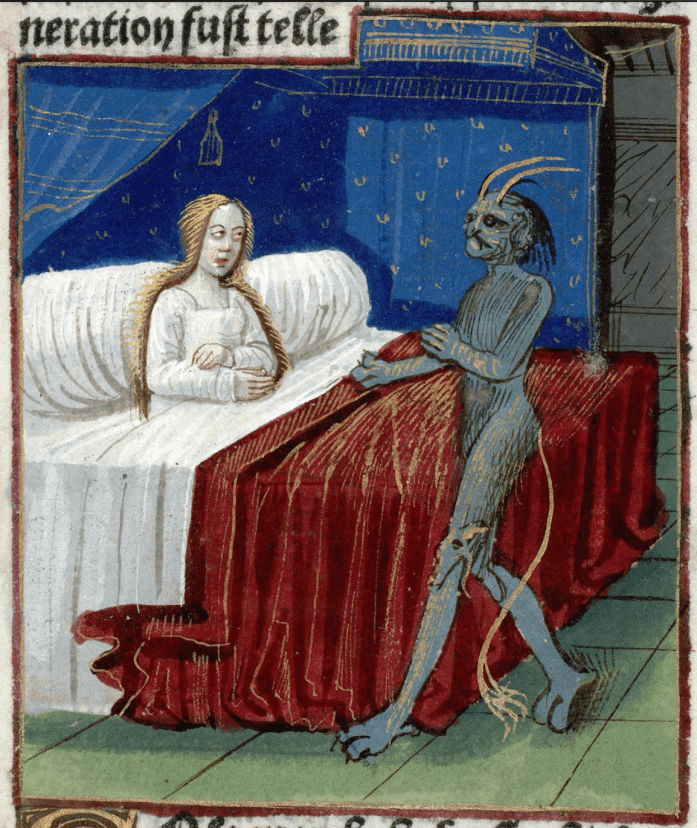
The story kicks into gear about 450 years after the crucifixion. We begin with the devil in hell, and he’s annoyed that when Christ was crucified, all the souls in hell that were damned before Christ’s arrival were allowed to leave hell. So the devils decide that they need a man of their own on earth that can draw people into temptation. They are going to impregnate a human woman and she will bear this child. They pick one, Adhan, and they kill off her family one by one until they get to her. She is put in a tower until she has the baby. She has a friend who is a holy man, and he suggests that she have the baby baptized right after birth, which she does, and this allows the baby to keep the powers he got from the devil but work for good. And this baby is… Merlin.
But the punishment for having an illegitimate child at that time is death by burning, so Adhan goes on trial, but by one year old Merlin can talk, and he ingeniously saves his mother from burning and gets to go home with her, where he declares that his life will be dedicated to raising a king named Arthur. And this is the story told in the first book of my series, A Man of Our Kind. One of the goals of my series is to put back a lot of the stories that Malory left out, and provide a full, cohesive version of the entire story in a way that makes sense and is involving for people today.
Also in this part of the legend is the story of Vortigern. He’s a bad guy who has the king killed and eventually manipulates himself into being king. The real heirs to the throne, Pendragon and Uther, go into hiding because they know they will be killed next. Keep an eye on Uther because he goes on to become Arthur’s father.

Vortigern invites the Saxons to settle in Britain, and this is bad because not only are they bad neighbors who just want to take over, they are pagan while the rest of Britain is going Christian. In Le Morte d’Arthur, the Saxons are referred to as Saracens. Things go too far when Vortigern marries the daughter of the Saxon leader, inspiring Vortigern’s own son to lead armies against him. It’s a twisty story where Vortigern is defeated, but then his son is killed, and Vortigern ends up being king again. So the story of Merlin’s birth and the first part of Vortigern’s reign make up the first book of my series and are the first part of the full King Arthur story.
But something interesting. The earliest versions of Merlin’s origin have him as a wild man of the woods. In 1136 we have the story that an incubus lay with Merlin’s mother, but at that point it was just a random spirit. The Vulgate Cycle,which casts everything into a Christian context, makes Merlin’s father the literal Christian devil, and he is redeemed through the intervention of the Christian God. But since this story was added after the bulk of the saga was established, it has the effect of casting the entire tale, the entire Arthurian legend, as the result of a failed takeover attempt by the devil. Kind of a big change, right? And then after this story is over, the narrative completely drops this angle, and it is never mentioned again. Someone might say Merlin’s father is the devil, but that’s about it—kind of a huge element to just drop, right? For my telling, I found the story of Merlin as the devil’s son gave Merlin some personality and also a character arc, because otherwise Merlin is just perfect and he has no way to develop. It also is aligned with the quest for the Holy Grail toward the end of the saga and is more cohesive with the entire story, so that’s the version I went with.
The three kings that precede Arthur
As the story goes on, Vortigern is afraid that Pendragon and Uther, the rightful heirs to the throne, are going to come back and overthrow him. He’s trying to build a tower to keep himself safe, but it keeps falling. He calls Merlin for help. So this is when these two stories come together, as Merlin joins Vortigern. Merlin reveals that there are two dragons under the tower, and they dig them up and the dragons have a huge fight. One of these dragons is red, and this becomes the red dragon that we still see on the flag of Wales today. That flag refers to this legend.
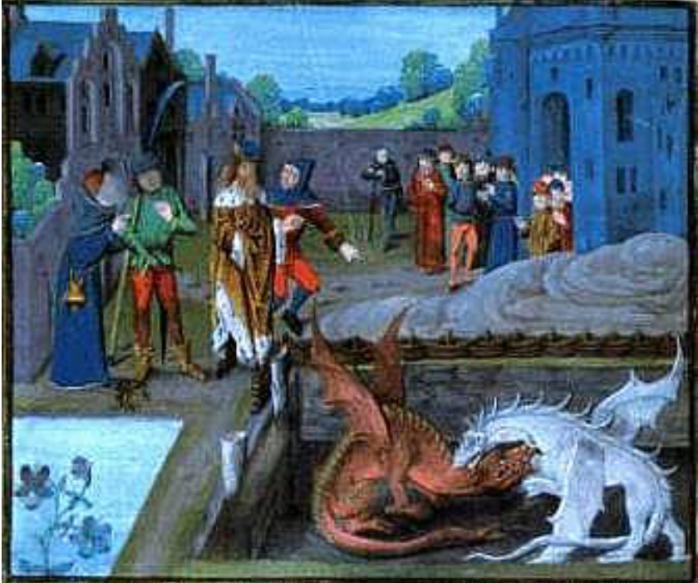
The two dragons have a huge fight, and the white one loses, causing Merlin to tell Vortigern that the fight signifies his own forthcoming defeat at the hands of Pendragon and Uther. There’s a great little Merlin moment when Vortigern says, “Tell me how I can avoid my fate,” and Merlin says, “There is no way to avoid your fate.” And then Vortigern says, “Then tell me how I will die,” and Merlin replies, “I am telling you how you’ll die.”
Not long after the dragons, the brothers do return and overthrow Vortigern. Pendragon is made king, and Merlin sides with him. He goes for a while, and there’s a fun little sub-story of an advisor that tries to outwit Merlin—never a good idea—and eventually Pendragon dies in a big battle, and Uther is made king. Uther takes on his brother’s name and thus becomes Uther Pendragon. Merlin builds the Round Table for Uther, and he also makes Stonehenge. Did you know that Merlin made Stonehenge? That is there in the legend. I love how no one at the time knew how Stonehenge was built, so they just said, “Well, Merlin must have done it!”
So this is all the story told in Book Two of my series. And now that we have Uther as king, we are at the point where Malory’s Le Morte d’Arthur begins.
So why did he leave all that out, and do you even need to know it? He obviously left it out because it doesn’t directly contribute to the King Arthur story, and yet… I don’t know, I find it resonant and fascinating. It sets up the world that Arthur came into, and how the coming of Arthur changed that world. The story of Vortigern is very compelling, and he’s just an intriguing character. I like the contrast between the brothers Pendragon and Uther, and Uther as a figure really hangs over the entire Arthur story. As I write my books, I find myself constantly referring back to Uther. There’s just something intriguing, mysterious and tragic about him. As I said, a big theme of the Arthurian legend is the passing of generations, and what one generation passes down to another, so this covers the generations leading up to Arthur and sets the context for the world he enters.
But we do have Uther at the beginning of Le Morte d’Arthur, and we’re now up to the point where it begins, so see you in the next chapter and we’ll start reading that together.
< < < Back to Part 1: What is Le Morte d’Arthur?

 The Swithen