
How to Read Le Morte D’Arthur
So let’s say you’re interested in getting to the bottom of all this King Arthur stuff and you want to know the real story. You soon find Sir Thomas Malory’s Le Morte D’Arthur, and not long into it discover that it isn’t exactly the pulse-pounding thriller you might have expected. In fact, it’s pretty dang hard to read!
But fear not, because I’m going to give you some priceless tips on how to approach this work, which will really help as you try to dive in.
By the way, I have recently started a Guided Reading of Le Morte d’Arthur, where I will walk you through each chapter and tell you what’s going on and what it all means. Check it out!
.
How did Le Morte D’Arthur develop?
First, we need to understand what Le Morte D’Arthur is, and how it developed. This is crucial to knowing what you’re getting into, which will make reading the work much easier. If you like, you can get all the fascinating details in another piece I’ve written, on the Development of the Arthurian Legend, although we’ll touch on some of the highlights below.
The first thing to know is there is no one story of King Arthur. It seems there was this real guy Arthur back around the year 500, and he fought some wars, but more importantly, a lot of stories started building up around him. This is what makes this a true legend, because all these legends developed around this one real man.
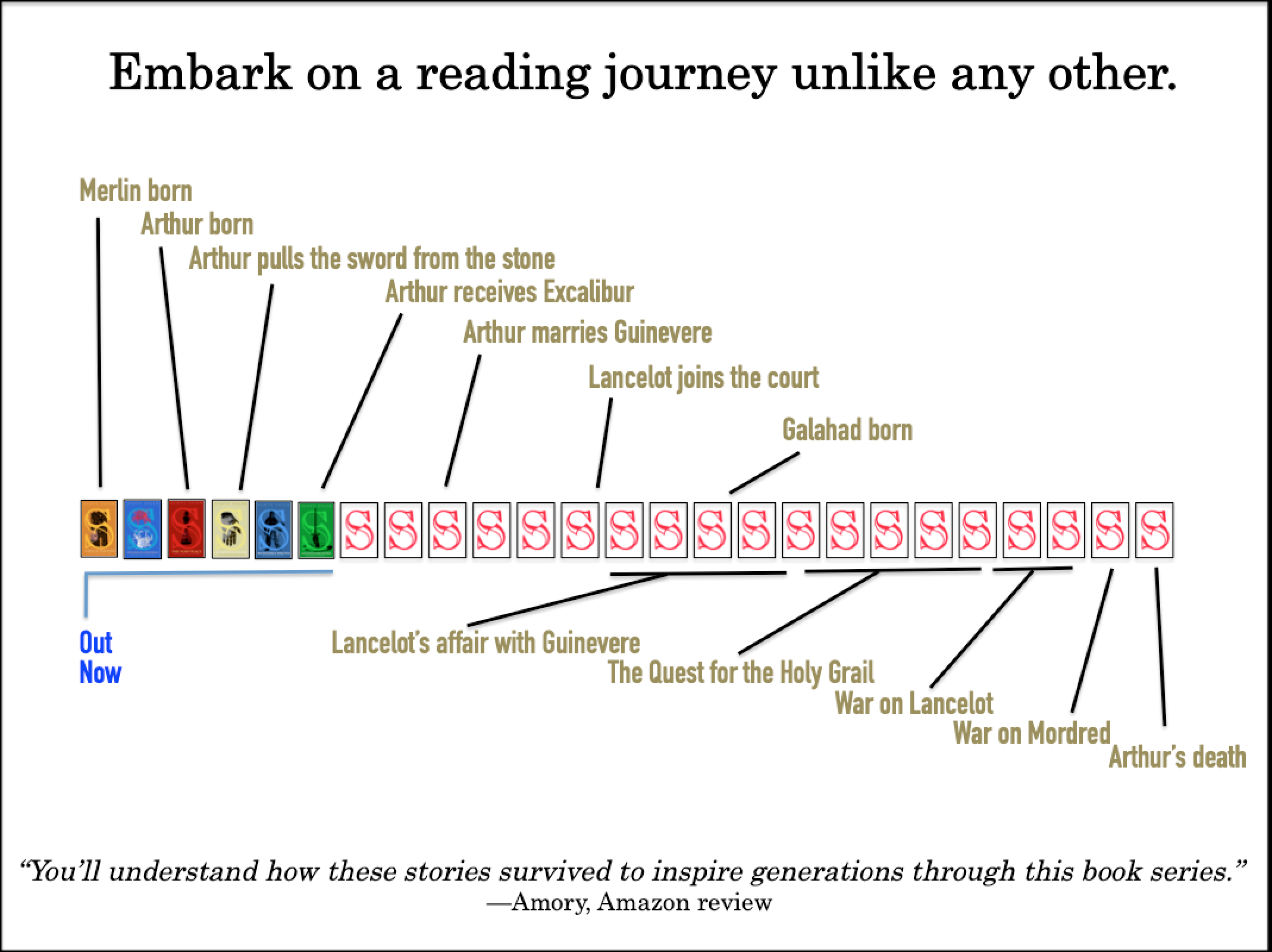
The other thing is that it’s a bunch of different stories written at different times by different people. It was never intended to be one coherent story. We’re talking people in England, in France, all over Europe, writing separate stories about King Arthur and his court, like early fan fiction. One of them added Merlin. One of them added Lancelot. One of them added the Holy Grail. But these were not conceived of all together, they were added piecemeal.
So the amount of story grew to huge size. There was one version that combined most of the stories into one long saga, in the 1200s, but that was about 3,000 pages. Le Morte D’Arthur is only about 1,000 pages. What happened?
Sir Thomas Malory arranged the stories and brutally shortened them. He was in prison, and what he did, perhaps to pass the time, is he took all these stories and arranged them into an order he liked, and he shortened them way down, leaving out huge chunks of story in the process.
So what you’re reading in Le Morte D’Arthur is Malory’s shortened compilation of all these stories, making it the only telling of the Arthurian legend by one author. It became so popular—not least because it was published right at the invention of the printing press—and became so famous it is now considered by most to be the definitive version of the Arthurian legend.
So how do you read Le Morte D’Arthur?
First, slow down.
Because Malory shortened the story so much, huge events of massive importance are flying by thick and fast, and if you don’t stop to process what’s going on, you won’t get it.
For example, in one chapter, we have the story of how Arthur was born (this story makes up the whole third novel of my series, so you can see there’s a lot to unpack there). It also has him pulling the sword from the stone, being coronated as king, at least three major battles, meeting Merlin, conceiving and trying to kill his own son, meeting Guinevere, nearly losing his head over a magical beast, learning who his real parents are and getting the sword Excalibur. All in 50 paperback pages!
Imagine the plot of Star Wars described as “A farm boy gets involved in an adventure to save a princess and ends up destroying his enemies’ biggest weapon!” That’s kind of what Le Morte D’Arthur is like. If you don’t slow down and think about it, you won’t get what’s so great about it.
Take time to think about it.
Now, this is only my opinion, although I am a guy who has been reading and studying the Arthurian legend for years, and am writing a whole book series interpreting it, and I say: the thoughts it makes you think are where the real action is. It presents a number of different moral and existential questions, and presents them in such a way that it prompts you to think them through.
For example, King Arthur has a son with his half-sister (he didn’t know it was her). Merlin says, “You know what, that kid is going to be your ultimate downfall.” Arthur has all the babies born on that day killed in order to escape his fate. Guess what? The one kid escapes, comes back and ultimately kills Arthur.

It’s up to you to think about all that, and think “What must Arthur be thinking and feeling? How does Arthur feel when he’s giving the orders to have the babies killed? What do his knights, and his subjects, think about his decision to do that? What does the boy think when he finds out what his dad tried to do? How does Arthur feel when he finds out his plan didn’t work?” And on and on. It presents a number of moral quandaries and prompts you to think about them.
So yes, there’s the adventure and the romance and the magic, but to me, the thoughts the book causes you to have are the true greatness of the work. If you get into it, eventually it will blow your mind on multiple levels, and I will warn you that most people who get to a certain point of exploration of the Arthurian legend eventually get completely obsessed.
Now, let’s talk about the language.
The book was written in 1485 and is in Middle English. Most editions you will come across have been translated to some degree, and there should be a glossary of some unfamiliar words. If you can read Shakespeare easily you’ll have no problem, but if you’re just coming into it… I say just relax and try to go with it. You might not understand everything, but you’ll get the general gist. And if you do get into it, there is some wonderfully poetic and beautifully expressive language.
Be attentive to family relationships.
Understanding the family relationships going on will add a whole new layer of meaning, and I have to tell you, they are not called out for you. So for example, Arthur’s mother is the mother of his enemy Morgan le Fay, making her Arthur’s half sister, and also Margause, who is the mother of Sir Gawain, who becomes Arthur’s best buddy. Lancelot comes from a different family line from Gaul (now France), and his background and relatives become very important as the story moves on. One thing I’m doing in my book series is making the family relationships clear, because once you understand them, they are very, very important.
Be open to surprises
Because the stories that make up Le Morte D’Arthur were never intended to be one cohesive story, some of them—particularly in the first half—are actually happening at the same time as some of the others. Sometimes there is a long time period between chapters which they don’t tell you about. Just relax and let it happen.
Another thing is that if you’re not familiar with the actual story, some things are not going to be what you expect. It’s not so much about heroism as you might think, it doesn’t dwell as much on the romance as you might think, especially if you’ve only watched movies, and none of these elements come to neat conclusions like we’re used to. Also, Merlin’s story might go in a direction you don’t expect. Just be open and go with it.
Very few tidy endings
For the most part, the stories don’t really end, they just weave into another story, or a few stories. Sometimes you break a story to insert another little story—that doesn’t make any sense—and sometimes you go back to the main story, or sometimes you go into another story. Sometimes it seems like the story is over, but then there’s another little story thrown on at the end. Just follow where it leads. This technique of interweaving a few stories is one of the great things about the Arthurian literature, and is among the things that provide interesting thoughts, as you think “Why are these two stories together? How does this one build on that one?”
Tristram
In the middle of the work, you might start to say “Who is this guy Tristram? What’s he doing here? And will he ever go away?” He is Tristram, also known as Tristan of the famous opera Tristan and Isolde. He was in a separate strand of Arthurian literature, and Sir Thomas Malory just decided to wedge him in there, right in the middle of the main story, in a way that might, you know, kind of… annoy you.
Now, this is bad literary advice, and not what your lit teacher might tell you, but if you’re just reading this for fun, you might just want to skip the Tristram chapters. You will not face any penalty on your taxes, you will not be disinvited to parties, and you might just be happier in the long run. And you can always go back! Just pick up again at chapter 11 for your Arthur/Lancelot/Guinevere/Gawain story, already in progress.
The Quest for the Holy Grail
Another thing I might just want to point out is that the quest for the Holy Grail is pretty far out there. We’ve been left with the impression that the quest for the Holy Grail is the crowning achievement of the Arthurian world, and a big WIN for King Arthur! They make a bold play for it, and they achieve it! So as you read, you may be confused when, gosh, it all seems like despair, death and destruction. Well, that’s because you’ve heard wrong all these years! The truth is that Arthur begs the knights notto go on the quest. Most of them learn that everything they have held dear their whole lives is wrong. In short, they don’t triumph, but instead they get their asses kicked.
The other thing is, because this part of the story comes from still another source, don’t be surprised when the whole moral universe of the story changes, then afterward, abruptly changes back. It’s like you’re in Lord of the Rings and suddenly you’re in Game of Thrones. The whole world changes for three chapters, and then—it changes back!
So what’s so great about it?
The majesty, sweep and heartbreaking scope of the entire epic makes it incredible and unforgettable. When you slow down and start to think about the resonances and meanings, the actions and their far-reaching consequences, they become incredibly poetic, profound and beautiful. Arthur’s mother is all but destroyed in giving birth to him, and her daughters set about destroying him. Arthur fathers an illegitimate child and tries to have him killed, only to have that child come back and try to kill him later. Lancelot is the perfect knight, only his weakness for Guinevere, Arthur’s wife, ultimately prevents him from achieving the Holy Grail. The whole thing is rife with these kind of ironies and poetic conclusions, gathering such force by the end that the entire thing is undeniably powerful.
 The Swithen
Pingback: Who was Nimue, the Lady of the Lake? – The Swithen
Pingback: New video: How to read Le Morte D’Arthur – The Swithen