
The Green Knight: Movie Review
I’ve been looking forward to seeing this movie for over two years. The first trailers were out far before the pandemic and promised an artful, thoughtful version of Sir Gawain and the Green Knight, one of the most famous and best-regarded works of Arthurian literature. Now the film has finally been released and we get a chance to finally see what it’s all about. The look is great, the visuals and sound are great (with a special emphasis on lighting), and the rest is, well, curious. Especially to someone familiar with the source material.
I am the author of a series of Arthurian novels that strive to remain faithful to the actual Arthurian legend as laid down between 1136 and 1485. The reason I set faithfulness to the actual legend as a goal was exactly because too many modern books and movies insert so much of their own material into the stories, try to re-form and re-shape it into more modern narratives, and basically just don’t trust the material to be good enough on its own. And what they come up with usually just isn’t that good. The original has lasted 800 years, right? Maybe they were on to something?
Unnecessary “improvement” is very much the case here, which changes so many fundamental aspects of the source I am not sure it can be called an adaptation. Yes, the basic plot is there, but the main character is so different the entire meaning is skewed. Hamlet is about its main character’s weakness and indecision, but if we make the main character strong and decisive… would that still be Hamlet? If we made a new Batman movie where Bruce Wayne had a loving and stable childhood with both his parents and decided to improve Gotham City as a social worker… would that still be Batman?
I ask because the Medieval poem of Sir Gawain and the Green Knight is about Gawain as an experienced knight of unimpeachable heroism, with a total commitment to honor, and what happens when that heroism and ideal of honor is tested. So if you switch out the character with a weak drunkard and slacker, not yet a knight and having had no adventures, you pull out the core of what the story is, and the castle it’s built on collapses. I was indeed open to discovering whatever writer/director David Lowery had in store for us, even if it deviated from the legend (I must say I had a great time at Guy Ritchie’s Legend of the Sword, which has nothing at all to do with the legend). But with such a fundamental misunderstanding of the material, you’re not watching an interpretation of the legend, you’re watching one writer/director’s personal ramblings based on his flawed understanding of the material. So now you know my perspective going in, let’s talk about what’s here.
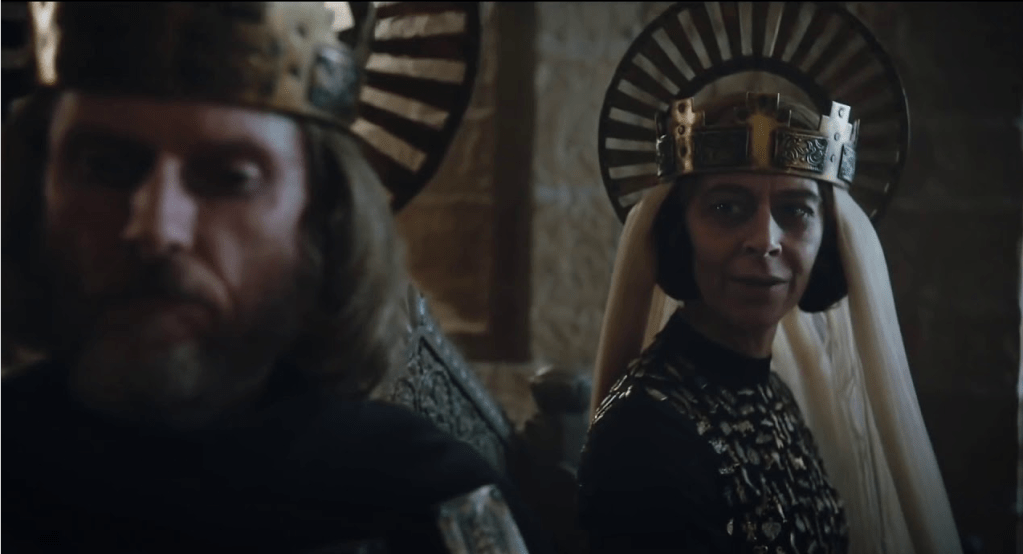
We open with Gawain waking from his drinking binge with his girlfriend. He returns home to his mother, Morgan Le Fay, then goes to meet Arthur and Guinevere and the rest of the Knights of the Round Table for a Christmas celebration. Arthur and Guinevere are quite a bit older and more sickly than one usually pictures them, or than they are in the source poem, but it kind of works. By now one has noticed the refreshingly different view of the time as not colorful and magical, but gray and drab and dirty, the interiors dark and grubby. I was into it! One is also starting to notice the careful use and attention to lighting, which is also excellent throughout. These things, the look, atmosphere and lighting are far and away the best things about the movie.
Arthur calls him over and they discuss when Gawain will have adventures of his own and become a knight. Meanwhile mom is upstairs conjuring an adventure, which requires a lot of special effects and horror movie tone (a lot of the movie has horror movie tone slathered over it… like when Guinevere suddenly becomes possessed and speaks with a man’s voice), and then the Green Knight comes in. The source poem makes clear that the knight is still human, but Cliff’s Notes will tell you that the knight represents nature, so this Green Knight looks like a tree come to life (or Groot’s dad). The next beats follow the tale; the Green Knight asks a knight to volunteer for a game, take a blow at him and, in a year, be prepared to receive the same blow. Gawain volunteers and hacks off the knight’s head, which the man then grabs, says “See you in a year!” and takes off. Before he leaves, mom gives him a green girdle that she says will protect him.
Now in the poem, we know that Gawain’s honor is so important to him that he would never shirk a promise, and so the whole question is how will he face his upcoming certain death? Here Gawain questions whether he should go at all, and we are to see his maturation as he travels across the country and has strange adventures. The poem does mention strange adventures on the way, but one might also note that there’s a reason they are confined to only a few lines. Here they take up the remainder of the first hour. First he is captured by scavengers who cut his green girdle but very kindly leave behind his valuable sword, which seems highly unlikely. Then he encounters a spooky ghost, who wants him to retrieve her head. Then a series of Godzilla-sized white-skinned giants happen by and regale him with a song. It makes for nice imagery, but seems like the main creative reason for these sequences was to answer the question: “What if the Arthurian legend was SPOOOO-KEEEEE?”
Dearest reader, you will encounter spoilers now. I think there’s not so much in the way of plot surprises, but if you’re concerned, pick up after it says “Spoilers End.”
SPOILERS > > >
I was ready to start fast-forwarding at that point, but luckily we then come back to the story. Gawain is taken in by a Lord and his Lady at a little manor. The Lord goes out hunting by day and Gawain is left alone with the lady and her cleavage (which actually IS mentioned in the source poem). The woman gives him a book and paints his portrait (which is quite finished for a few hours’ sitting), and that night Gawain hangs with both of them. The Lady gives such a long, impassioned monologue on nature that I became embarrassed for the actor, Alicia Vikander. Then the Lord proposes a game; he’ll give Gawain the spoils of his hunt and Gawain will give him whatever he gets in the day.
The next day the Lady gives Gawain a green girdle just like the one mom made, saying that no harm can come to him while he wears it. Then she gives him a handjob! Yeah. No kidding. And we do indeed see the sticky result, right on his new green girdle! (Symbolism klaxon sounding!) Then Gawain decides he has to get out of there! On his way out, he meets the Lord, who asks for what Gawain received that day. Gawain only gives him a kiss—not the girdle, and not the handjob. He then hot-foots it for the Green Chapel.
Arriving a day early, he sees the Green Knight apparently in a sleep and apparently grown into the foliage of the place (remember, Cliff’s Notes say Green Knight = Nature). On Christmas morning the ol’ green guy wakes up and comes down to chop off Gawain’s head. Gawain jumps away at the last moment, then finally gets up and says forget it! He goes outside and finds his horse right there! He goes back to Camelot and Arthur dies in a moment and Gawain is made king! He marries his sweetheart (present earlier in the film) and she becomes queen! Then he does poorly in battle, they lose, the people give him mean looks! He pulls the green girdle out of his own body, and when he does, his head falls off!
But wait! Before you can say The Last Temptation of Christ, he’s back under the Green Knight’s axe! It was all a vision! He decides to remove the green girdle—as in he is removing his false protection and going to take it like a man—and says “Now I’m ready,” and in case you missed that, adds “I’m ready now.” The knight moves to strike and—title! The end!
< < < SPOILERS END
Now let’s talk about how the actual poem ends. In the poem, Gawain spends three days and nights with the couple, and the host announces the game on the first night (meaning three nights of the game, not just one, as in the film). Gawain succeeds in fending off the lady’s advances for the first two nights, and he gives the host what he receives; only kisses (no handjobs). But on the third he does accept the green girdle that he is told will preserve his life (there is no green girdle prior to that), and he does not tell the Lord about it. The next day he goes to the Green Chapel, and at the first two blows he flinches, but on the third the knight only nicks him. Then we discover that the Lord and the Green Knight are the same person,and the previous three days of the exchange game was the test of honor.The knight tells Gawain that he passed by acting honorably, and he can be forgiven for lying about the girdle because any man would want to preserve his own life. Gawain goes home happy and still headed!
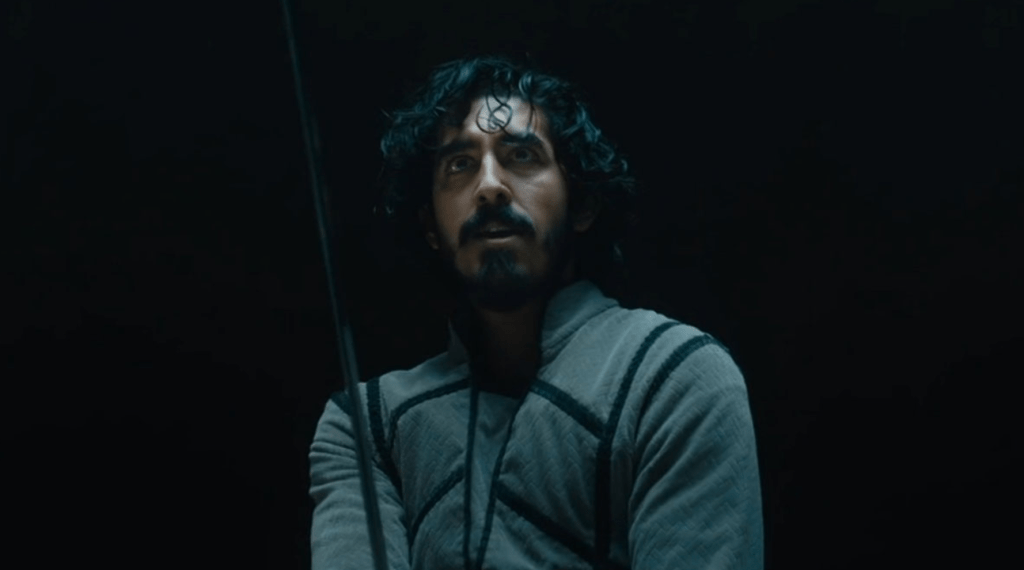
Now in the film, the Green Knight and the host are played by two different actors, and we never actually find out that the host and the Green Knight are the same person, and the seemingly unrelated exchange game was the test of courage. This is the biggest mystery for me—why would he change that?—as it is kind of the whole point of the original material. What the film replaces it with a tepid statement about not relying on false courage, which, yeah, false courage is bad, I guess. Nowhere near as epic, significant and moving as the events of the original, but still true too, I suppose.
I watched this movie with my partner, who is far less familiar with the source. I spent a lot of the film telling him, “Guinevere does not become possessed. Arthur does not just hand Excalibur around. There’s no scavenger. There’s no ghost. There’s no singing giants. There’s no talking fox. There’s no handjob.” But my partner made an interesting comment that illuminates the differences between this film and the source when he said “There’s no tension, because I know how it’s going to end.” In Arthurian literature, we often know what is going to happen, and they use that to deft literary effect because the a big theme is destiny and the question of whether our fates are predestined. So in the source, because we know that Gawain is the most peerless of knights, there is no question that he will fulfill his promise, and tension is generated by wondering whether he will die. Here, because Gawain is a young, shiftless drunkard and slacker, we only have the old “young man gains maturity” narrative, undercut by the fact that Gawain seems to wander aimlessly through his own adventure without developing in any way.
So, as a movie, if you remove all comparison to the source? Pretty, but empty, uninvolving and long—so long. Lowery seems to belong to a new generation of filmmakers, like Ari Aster of Hereditary and Midsommar and Robert Eggers of The Witch and The Lighthouse, who can recreate the look and pacing of an art film but without the substance necessary to make it thoughtful or moving. If it’s pretty, long and boring, it must be an art film.
I never quite understand the impulse to take something that has endured for centuries and say “This is fine, but I can think of something better!” This is exactly why the challenge I set for myself with my Arthurian series of novels is that have to remain faithful, no matter how little it makes sense, because… let’s just trust that they knew what they were doing! There’s nothing wrong with flights of imagination and creativity in service of the story, but it’s unfortunate that Lowery had a source rich with meaning and resonance, and which has lasted the ages, but he decided it wasn’t quite as good as what he could come up with. Well, we’ll see how much his film is discussed 600 years from now.

 The Swithen
Great post. Boy, I didn’t even get that Gawain’s mom is Morgan le Fay and she conjured the adventure – why would she do that? The film was visually attractive but strange. I felt like I was watching a German-Indian story rather than a British one. I think I need to watch it again to pick up on everything. I feel like overall it lacked the goodwill of the original, despite the scary moments in it.
Tyler Tichelaar
LikeLike