
Why are there no good King Arthur movies?
When you mention King Arthur, or God forbid, another Arthurian film or TV show comes out, you often hear the dismissive “King Arthur is so played out,” or the more measured “King Arthur just doesn’t work on film.” And when all the films and TV shows are so genuinely awful (to varying degrees, of course), you have to agree! When Monty Python and the Holy Grail is considered one of the best and most accurate depictions of the Arthurian legend, you know there’s a problem somewhere.
As the author of a series of Arthurian novels, and someone who has spent the past ten years studying the Middle English texts, I’m dismayed when people say he’s played out, because so few people know what’s actually in the legends—despite how familiar we all think we are. But as for whether King Arthur doesn’t work on film… well, they’re right. And there are a couple of reasons why.
It’s too big.
The real Arthurian legend spans about 80 years and begins a generation before Arthur is even born. Then it follows Arthur and his cohorts—Guinevere, Lancelot, Sir Gawain—from youth through middle age and right up to death, with a lot of other characters and a lot of little stories along the way. It is a true epic, in the real sense of the word (not the Zack Snyder sense), and as such, it’s greatness comes from its size and scope. It just doesn’t chop up into little parts. When you do the parts, you lose the whole, and when you do the whole, you lose the parts.
The only movie that tried to do the entire Arthurian legend from start to finish is Excalibur, and while that is a wonderful film with several amazing visuals, you have to admit that the storytelling is a mess and the camp meter is in the red zone. You really only get a feel for what the legend is, and in its own way, that’s enough, although you wouldn’t be much closer to knowing what’s in the actual legend.
It’s too weird.
Dark Ages and Medieval writers, well, they just didn’t have that much Peak TV to draw from. Their stories come from a world where most people couldn’t read or write, didn’t have communication with the next town over, let alone other countries, and had no formal system of education and only the most basic governments. So the stories they come up with, well, they’re going to be a little different. And we can say “Oh, they’re useless and irrelevant,” or we can say “Wow, they’re wild, intuitive and poetic in a wonderfully evocative way.” Or at least, I say something closer to the second statement.
A typical story in the old legend is that there is a king who is a tyrant. He killed the current king, sending the king’s young brothers into hiding. He is trying to build a tower to protect himself against the inevitable uprising of the people, but the tower he is building keeps falling. His psychics tell him that he needs the blood of a fatherless boy to put in the mortar of the tower to make it stand. They find the boy (that’s Merlin, btw), but he tells the king that the real reason the tower won’t stand is because there are two sleeping dragons under it, a red one and a white one (FYI, the red one is still the symbol of Wales to this day). They dig the dragons up, they fight until one wins, and the king builds his tower. But Merlin tells him that the outcome of the dragon’s fight means that the brothers of the king are coming to overthrow him, and that he will die in his tower. They do, he does, and then the story continues with the brothers as the main characters (P.S., one of those brothers goes on to father Arthur).
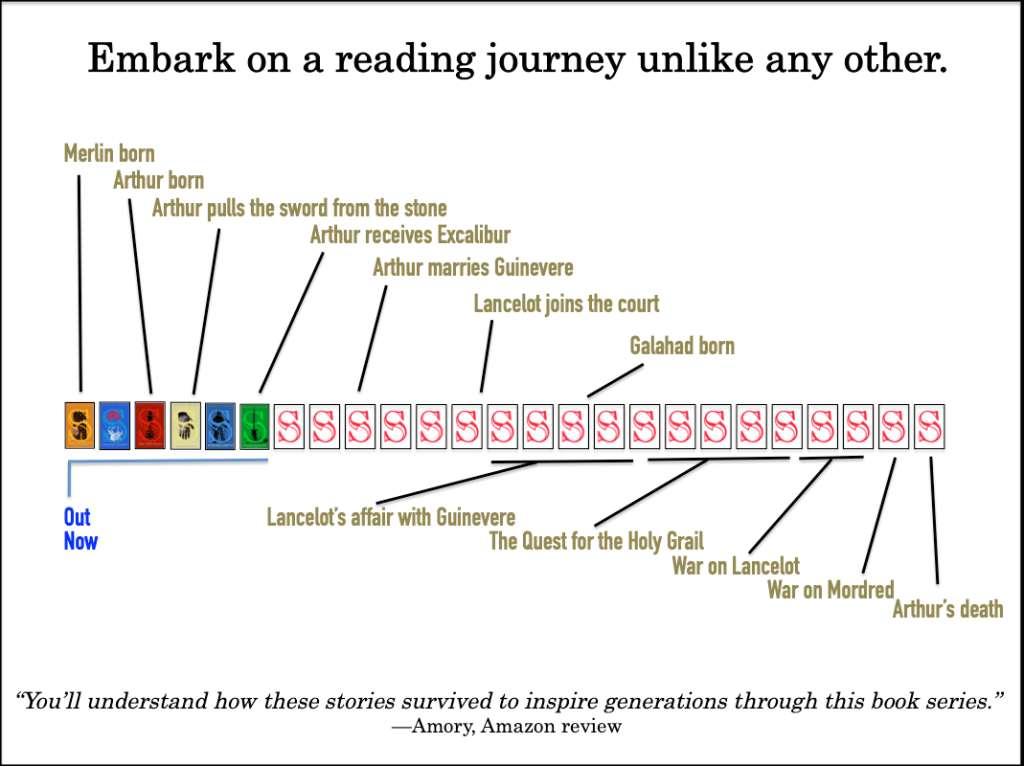
So you can see that a lot of it simply doesn’t make sense. Or rather, it makes a symbolic sense, rather than a clear A-to-B-to-C kind of sense. In movies and TV we are used to a more stringent logic (even if it includes magic or made-up science), and if the movie can’t provide that, most people reject it. On the other hand, if you hammer an Arthurian story into stringent logic, you lose what is beautiful and poetic about it. A related issue is that….
Arthurian stories don’t follow expected story beats
They kill the shark. They blow up the Death Star. They win the big game. Most of what we consider “movie satisfaction” has to do with everything coming to a clear, defined ending that resolves everything, so we can move on and feel that everything has been put right. Arthurian stories not only don’t end cleanly, often they don’t really end at all.
Take the story of the tyrant king above. He is overthrown, and we move cleanly into the story of the brothers who conquered him without much of an ending for him. Many times the story doesn’t come to an ending at all, it just threads into another story and the whole thing continues… because that’s what the Arthurian legend is; more of a tapestry of many different intertwining stories than a set of clear narratives. Because of this, you can’t even pull out one story and make a movie out of that. It is so intertwined there are very few stories that come to a defined ending at all. They mostly just twist into the next one.
It simply may not be explosive enough.
The actual Arthurian legend may simply not be exciting enough for audiences of today. There are no armies of the undead. There are shockingly few dragons (after that first dragon fight, there are almost no dragons). There are giants, but they rarely maraud cities. I’m afraid the whole thing is simply about human beings; their loves, friendships, achievements and failures. Because of this, most filmmakers try to juice it up, to make it more exciting for the present day, and in doing so, they usually ruin it. The fact is they simply don’t trust the material to be enough as it is, so they have to emphasize the brutality, enhance the magic or just generally jack it up to compete with modern entertainments. This is why works such as Lord of the Rings or Game of Thrones develop stories that are like King Arthur, but the writers or directors can mold and shape into the kind of story—with the kind of character arcs, consistent storytelling and endings—that make for a more satisfying movie experience.
A saga not made for movies
So maybe the takeaway is that a thousand-year-old legend is not necessarily made for the multiplex. It’s true; King Arthur doesn’t work on film. But don’t say the Arthurian legend is played out, or that everybody knows the story through and through, because unless you’ve gone back to read Le Morte D’Arthur or one of the earlier sources, you really only know the movie version.
 The Swithen