Author Interview: Merlin’s Origin Story
Greetings folks, just a note to point out that I have just added an author interview about the first book, Our Man on Earth, to The Swithen website. It gives insights into the character of Meylinde, how I came to understand her and her crucial role in the book and the entire series, as well as why I felt I had to go back and revise the book to make her a more full and fleshed-out character in her own right. This interview was originally available only as part of the bonus materials included in the First Trilogy Boxed Set, but now it’s here and free to all.
It’s a very satisfying time for me as the series is slowly starting to take off and gather fans, and I find that the first book outsells the others regularly—which is why I’m glad I went back and revised it! Not sure you know, but the main character of this book, Merlin’s mother, vanishes from the original legend once Merlin leaves her care, never to be seen again. That’s how it is in the Arthurian legends, folks! You get used and thrown away!
After developing her in such detail for Our Man on Earth, and going with her through all the torment and suffering she endures, I just couldn’t bear for her never to be seen again—but, I did say that I’m going to follow the original legend to the letter. Luckily, I was soon able to find a way to keep her in the series while remaining faithful to the legend, but that opened up the question of how weakly she was presented in the first novel. I spent a week at a cabin in the woods in Ontario working on my revision every day, ultimately adding 50 pages to the novel to fill in her character as a person and let us understand her psychology and indomitable strength even better.
My reward is that she is, hands down, the most beloved character in the series so far (of course, everyone else is not all that nice, so it helps). It has been great to me to have her be so well accepted and loved, and to grant her the incredibly influential place she has, and will have, throughout the series.
Read the Our Man on Earth interview here
What’s it all about? [King Arthur, that is]

When you get past the bad movies and corny TV shows and go back to the actual Arthurian legend, what’s it all about?
Greetings friends, I’ve just put up the newest video in my “King Arthur 101” video series for YouTube, which takes a look at what the real legend of King Arthur is actually about. And you can conveniently find it, as well as a transcript, right here.
Focus on FUN!
In making the video, I actually realized something important about the way most people perceive the Arthurian legend. I’ve always wondered at the phenomenon of how people love Lord of the Rings and Game of Thrones but think that King Arthur is just stupid and boring. I always thought it was because almost all of the King Arthur movies we’ve seen are so lame (there’s going to be an upcoming video about why the movies are so bad), but in making the video, I realized another aspect of the way the legend is portrayed….
The thing is, we only hear about the triumphs of King Arthur and his knights… the knights in shining armor saving damsels in distress, the achievement of the Holy Grail (although geez, if that’s an achievement…) and stuff like that, because that’s the positive, fun stuff. The battles, the achievements, the triumphs… but the darker stuff, that gives the legend its depth and texture, is left out of most popular tellings.
Make room for failure!
In making the video it occurred to me that it’s the rise and fall of Camelot that gives the story its incredible poignancy. It’s the achievements and failure of King Arthur that make his story so moving. Because the story is so vast and epic in scope it’s hard to make a movie about the whole thing, and what we usually focus on are the wins, and thus from a distance, the whole thing can look a bit shallow and even vapid.
You can bet that I’m including the darker side as I write my Swithen novels because–another thing writing this series has taught me about myself–is that I like it as dark, complicated and tragic as possible! If I can make life even more difficult for my characters, I want to! And as the series progresses (we’re still writing Arthur’s young childhood at this point) a lot of that overwhelming, beautiful tragedy will be built right in.
Anyway, please watch (and share) the video, and take the time to let us know what you think. Best wishes– Scott
Legends come and go… why has King Arthur endured?

Most myths and legends get consigned to the realm of academics and historians… why has the legend of King Arthur endured all these years? That’s the question I answer in the first article and video in an informal video course I’m creating, which will offer a quick overview bringing people up to speed on everything the average person wants to know about King Arthur.
In this case, it’s a question of one author having the motivation (and the free time) to combine and condense a number of disparate works into one overarching narrative… one that then received an invaluable boost from a piece of technology that had just been introduced, and ensured that this tale could and would be found by generations of adoring readers for the next five hundred years. Find out the whole story in the video, and please, let me know what you think–or what other topics you’d like to see covered in upcoming videos.
The King Arthur 101 Video Course
As I mentioned, this is the first in a series of videos I’m making that’ll give a crash course in everything King Arthur. We’ll find out whether there was a real King Arthur, what the legend is actually about, what most people don’t know about the legend, why there are no good King Arthur movies, what works of art, literature and music the Arthurian legend has inspired… and so much more.
Stay updated on future releases by subscribing to this blog, my YouTube channel, adding yourself to my mailing list… or any of the other myriad ways we can be connected. And if you like the video, please feel free to share. More to come! I just need to free up the writing and editing time…
Book Trailer: The Void Place – The Birth of King Arthur
Yo! Finally finished the trailer for Book 3: The Void Place, which tells the story of King Uther’s lust for Igraine, the wife of one of his most loyal liegeman, and how Merlin helped him spend one night with her–the night that Arthur was conceived.
Now I have trailers for all three books which means that I can create a playlist on YouTube! Wooo! Now I’m getting to work on a 12-part video course that will give a quick summary of how we know about King Arthur, historical evidence, what we don’t know about the legend, what works of art and literature it inspired… and all that.
In the meantime, have a watch (just over 3 minutes) and let me know what you think. If you can’t see the video, you can go watch it here.
Three kings, two dragons, one novel

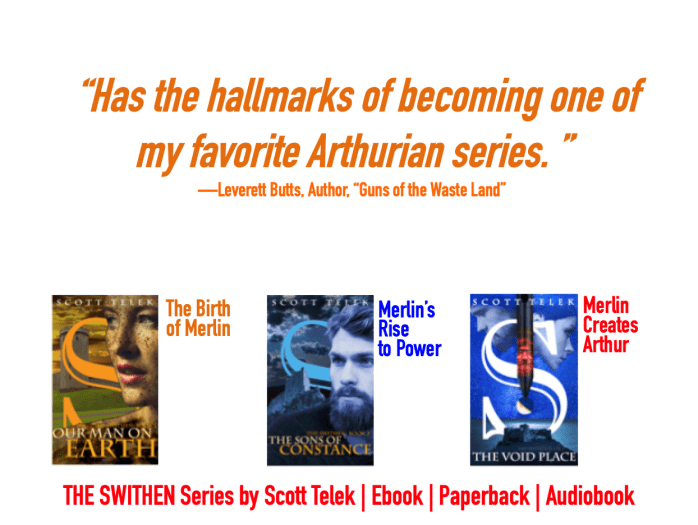
One of the main things people want to know when they read one of my books is what elements were from the real Arthurian legend and which ones were made up by me for my novels. (Hint: If it’s absolutely insane, it’s usually from the actual legend!) I just posted an article to the Swithen website that takes apart the second novel in the series, The Sons of Constance, detailing which elements are from the actual legend, and which were adapted for my novel. And you can find it all in Legend to Novel: The Sons of Constance.
This novel was a bit of a challenge because there were certain things that had to be included, but at the same time, they kind of screwed up having a nice clean beginning and ending. The first book, Our Man on Earth was a nice, self-contained story with a clear ending. Similarly, the third book, The Void Place, has a very clear ending.
Book 2 starts with a short story that had to be included–it has to go somewhere–but wraps up before the main action of the book gets started. So I decided well, these books are just going to be structured in a strange and unusual way–like the Medieval legends themselves–and I just embraced the fact that these novels begin one place and end up somewhere very different. Thus, now the first part of the novel is kind of like a separate novella, and then the main action of the story begins.
Similarly at the end, the climax of the book happens about 50 pages before the book actually wraps up. Again, there were things that had to go in this book–in this case, the creation of the Round Table–and just wouldn’t work in the next one. So the challenge was on me to write it in such a way that it held together on a thematic level, rather than presenting an extremely tight plot.
Because my series is really chopping one huge story into several smaller ones (my image is of one of those 8-foot sub sandwiches) one of the big issues is where to begin and end each story while making sure all the right material makes it into the book where it will be most thematically appropriate. Thus far, The Sons of Constance has had the most material that zigs and zags a bit from a straightforward thriller, but that also gives it a meandering charm that makes me love it.
Take a look at the article to learn what was from the actual legend from 800 years ago, and which characters I added or embellished to make it all work in a present-day novel.
 The Swithen